Proud partner

Proud partner
Article
Summary


If you delve a little deeper into SEO, you’ll inevitably come across all sorts of new terms, but it can sometimes take a bit of time to work out which ones are actually relevant to you and your website. One example of a term you’ve probably come across before is ‘rich snippets’. But who or what are rich snippets? And how can you use them to your advantage? You’ll find out in this blog post.
Before we can explain what rich snippets are, we must first discuss what a snippet is. A snippet is what Google shows you as a search result: the title, the URL and a short description (meta description) of the page. That is the information you normally see in a search result, but that snippet can be enriched with additional information that gives visitors an even more complete picture of what they are about to see.
And this additional information can range from product photos to reviews and from FAQs to stock information. Below, we’ve listed the main types of rich snippets for you:
Yes, we’re jumping from one English term to the next: breadcrumbs – the breadcrumbs that collectively make up your website. You can decide for yourself which are the most important breadcrumbs for your website and display them in your Google search results. If, for example, you sell clothing, you can display the main categories for your online shop here – such as jumpers, T-shirts, shoes and sunglasses.

Is the search result a specific product? If so, you can also display additional product information via rich snippets: for example, a photo, a video, the price, stock levels, delivery time, colour and available sizes or dimensions.
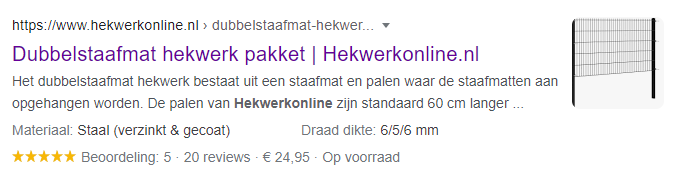
Also worth noting: the reviews. These can relate to either a specific product or your company. The review is then displayed in the way you’ve probably seen many times before, with 5 stars (which may or may not be coloured) followed by a score between 0 and 5.
The information you provide is, of course, most valuable when it answers a question. A rich snippet can therefore also contain questions that you can expand to reveal (part of) the answer, as you can see in the example. This provides further evidence to Google that your page actually is about the topic you claim to be writing about. An additional benefit of a rich snippet based on an FAQ is that you may also feature in Google’s general FAQ section and thus be displayed under the heading ‘People also ask’.

Rich snippets therefore enhance your discoverability, but rich snippets in themselves do not provide any SEO benefit. Google does not rank your website higher (or lower) simply because of the presence of rich snippets. What it does offer you, however, is that your page will stand out more in the search results; and because you are more noticeable and display more information, you will also attract more visitors to the page. This, in turn, is naturally picked up by the crawler, which interprets it as evidence of the page’s authority and will consequently rank you higher in Google.
Rich snippets can be created using structured data (apologies for yet another English term). Put simply, structured data is a way of passing information from your website to Google. You communicate with the search engine in code, as it were, and the search engine recognises this code and converts it into the rich snippets you have specified. Please note, however, that Google offers no guarantees. It is never 100 per cent certain that the structured data will actually result in rich snippets being displayed in the search results.
Creating structured data therefore requires code; you can write this code yourself or have your web developer create it for you, but fortunately most of the code can already be found at Schema.org. Their website lists all the so-called markup codes that you can use for the various types of rich snippets.
Is your head spinning from all the terms above, and does Schema.org sound like gibberish to you too? Then we’d be happy to lend you a hand with your strategy! Our SEO experts know exactly what needs to be done to make your snippets as attractive, relevant and comprehensive as required.




Our team is
ready to help you

