Proud partner

Proud partner
Article


Within marketing and communications, Cialdini’s seven principles of influence serve as a guiding framework. These principles are applied to influence people’s (purchasing) behaviour. By applying Cialdini’s principles, you can ensure that clients feel more connected or are more likely to make a purchase. Cialdini identifies seven principles: reciprocity, consistency, social proof, liking, authority, unity and scarcity. We’d be happy to tell you more about these principles.
Before we tell you more about the principles of influence, let us first tell you more about the man behind these principles: Cialdini. Robert Cialdini is an American professor and researcher. He specialises in the fields of persuasion, influence and power behaviour. In his book *Influence: The Psychology of Persuasion*, he describes the various strategies of influence. These can be used to win people over and get them to do things for you. Whilst these strategies are universally applicable, in this blog we’ll focus primarily on Cialdini’s work in relation to marketing.
Before we delve a little deeper into the subject, here’s a brief explanation of neuromarketing. There are many different definitions in use, so we’ll briefly explain what we mean by neuromarketing. Marketing itself is actually always defined as understanding the customer and meeting their needs. But does what a customer says actually reflect what they really think? Not really! In many situations, our brain works differently to what we expect. For example, we often make choices subconsciously and in an irrational way. This is because our brain operates on the basis of two systems:
We expect to make decisions under the influence of System 2. After all, we examine the specifications, look at reviews and so on. But it turns out that our irrational brain is active much more often and therefore has a far greater influence on our behaviour. Research has shown that 85 per cent of our choices are made by System 1. A major advantage of this system is the speed at which it operates. System 1 works many times faster than System 2, enabling us to react more quickly to stimuli from our environment. Understanding System 1 is crucial for the effective use of neuromarketing. After all, neuromarketing is not just about understanding the brain, but also about how we can subsequently influence it to guide choices. And this is where various principles come into play, including Cialdini’s influence techniques.
Now that we have a better understanding of exactly what neuromarketing is, it is time to move on to the principles of influence. In the book *Influence*, Cialdini explains several principles and how our brains respond to them. His theory is based on six principles that play a role in influencing and persuading your visitor. The interplay between these different elements is crucial. Simply capitalising on scarcity, for example, will not have the desired effect; we therefore recommend seeking synergy between the principles. Furthermore, it is always important to test your approach – naturally, you want to know whether your messaging is effective. A great option here is to use VWO or Hotjar. For example, test two different messages on a product page – one focusing on scarcity and one on reciprocity – and then measure the results. In this way, you’ll get to know your target audience a little better and can enrich the customer journey.
“Give something, so that you get something in return.” According to Cialdini, reciprocity is an effective way to influence people. Asking for small favours is very common in marketing – think of discounts, for example. If you run an online shop, you could, for instance, offer a 10 per cent discount on the next purchase for new customers or people who sign up for the newsletter. The customer feels that they are getting something from you as the online shop. This triggers two reactions:
You gain in reputation;
The likelihood of a client making a purchase is increased.
This need not be limited to the short term; it also works in the long term.
By sending an email with a discount code (also known as a ‘welcome flow’), you are applying the principle of reciprocity perfectly. According to Cialdini, reciprocity works as follows: you give something to the customer (a 10 per cent discount), the customer gives something back (providing their email address), and you then help the customer further (the customer can place an order using the discount code).
Think carefully in advance about what you want to achieve with a welcome campaign. What information will you include in the email? Consider, for example, the increased likelihood of a purchase. This type of email is generally read more thoroughly and opened more often than the regular emails you send to customers. By asking a question relevant to your business during the sign-up process, you can then tailor your automated email campaigns accordingly. For example, if you run an online sportswear shop, ask your customer which sport they play.
People like consistency; once we’ve made a decision, we’d rather not go back on it later. To achieve this, it’s important to make the first step as accessible as possible. Ensure that the visitor answers ‘yes’ to a simple question, so that the process begins. This could be, for example, in the shopping basket on the website, but also via the contact form or when submitting reviews.
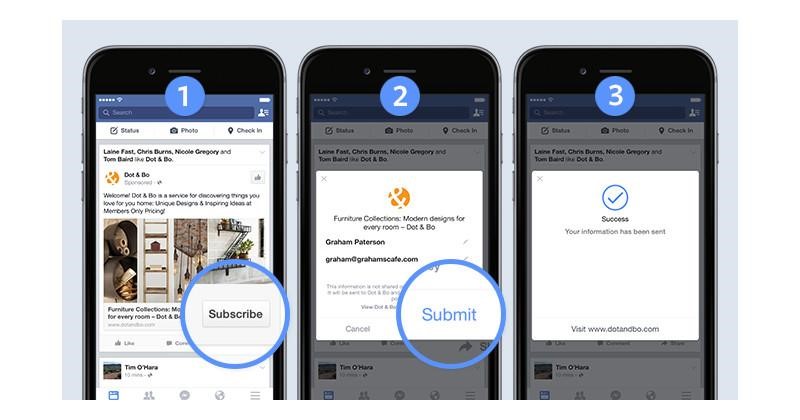
We also consider the option on Facebook to utilise lead generation to be a good example of this. Here, an advert can be displayed in which the visitor sees a button labelled ‘more information’. This is a relatively small step for the visitor, so a good CTR can be expected. The next step is actually even better, as the details are filled in automatically. Facebook automatically populates the fields, thereby lowering the barrier to taking the next step. Visitors then simply need to click ‘submit’ and the conversion is complete!
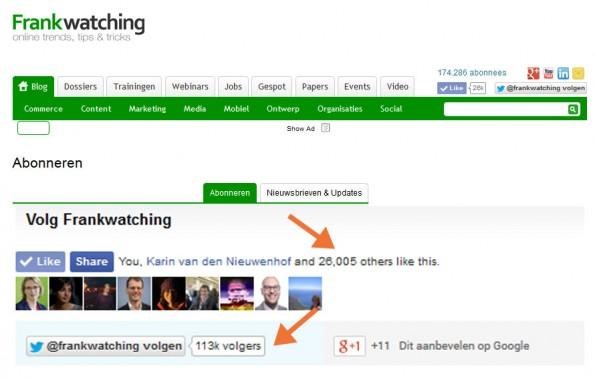
Peer pressure – you’ve no doubt heard of it. According to Cialdini, people look at the actions of others and make their own choices based on those actions. Take, for example, placing an order with an online shop where you’ve never bought anything before. If you know that lots of other people have had a positive experience there, you’re much more likely to decide to place an order yourself. It’s therefore a good idea for a business to show what others are doing. That way, potential new customers are persuaded to purchase products and/or services.
The example Cialdini gives concerns the cards you find in a hotel bathroom regarding the towels. These cards ask you to reuse your towels, as this is better for the environment. In an experiment, the wording was changed to ‘75 per cent of guests in this room reused their towels.’ What happened? The number of guests who did so increased by 33 per cent.
This concept of social proof, as described by Cialdini, naturally doesn’t just apply to reusing towels; it can also be perfectly applied within marketing. For example, online shops selling clothing often feature Instagram posts of people wearing the product. This isn’t just for inspiration, or to show how something looks, but also to persuade you to buy the product.
Another example of how to apply Cialdini’s social proof to a product or service:
By implementing widgets, USPs and testimonials on your website, you can easily capitalise on this principle of persuasion. In short, that USP stating ‘A thousand satisfied customers have already gone before you’ isn’t such a bad idea after all.
You like to say ‘yes’ to the people you like. But who do you like? According to Cialdini, this comes down to three factors. We like people…:
The same principle applies to a website. Visitors subconsciously feel more connected to a brand or company when they discover similarities. That is why it is wise to develop personas for your target audience. By identifying who your target audience is, where they are and what they do, you gain valuable insights. You can then use this information to map out a customer journey. In this way, as an organisation, you can develop relevant touchpoints through which you engage with your target audience. By highlighting these similarities at those specific moments, you can build rapport. That is why you often see companies sending emails in the name of an employee. If you keep doing this, after a while the recipient will know who it’s from. This is an easy and personal way to build relationships.
People tend to heed authority without giving it too much thought. When an expert says something, we often expect it to be true. But how can you apply this principle to your website? Write interesting blog posts, organise events or share research findings. That way, you’re building thought leadership! This means you’re seen as the go-to expert in your field, and the big advantage is that people come to you for help. From this perspective, authority is closely intertwined with reciprocity, because whilst you’re showcasing your knowledge, you’re also giving something back to your visitors. Another good example of this bias is highlighting partnerships with other organisations and showcasing awards and certificates.
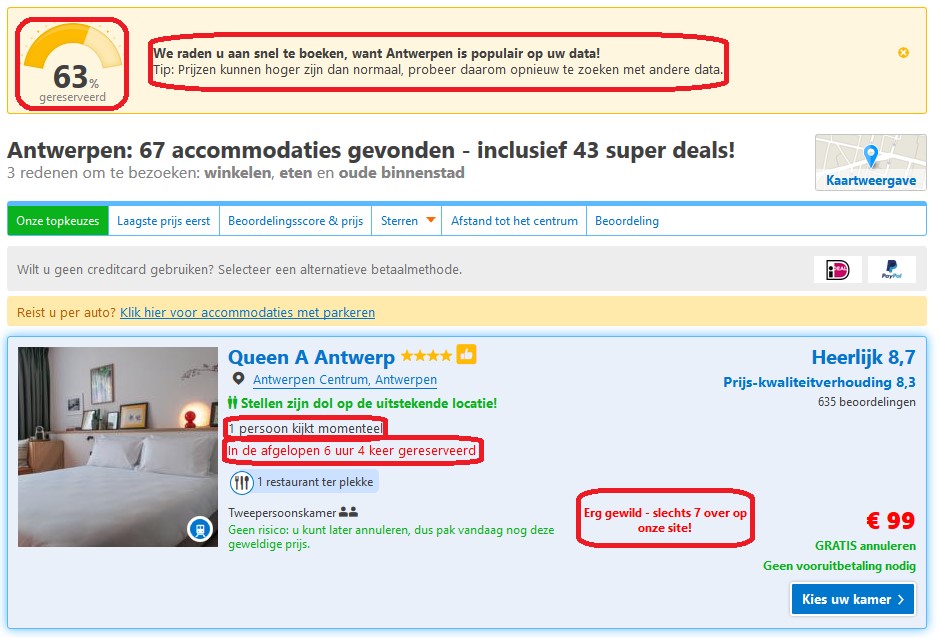
Cialdini concluded: scarce products and services are more sought after. If the production run of a product is limited, or if a product is only on offer for a short time, people become eager to get their hands on it. According to Cialdini, limited production runs in particular have a strong effect. This is because it gives people a sense of exclusivity. It acts as a booster to the value of a product or service. Take, for example, the new iPhones when they are released. These are always only available in limited quantities. Customers are then all the more keen to get their hands on this product.
You’ll probably recognise this straight away – just book a hotel via Booking.com and you’ll soon come across the principle. “Only 1 room left”, “5 others are currently viewing” and so on. Whilst we may sometimes find all these notifications slightly irritating, the brain works differently. Because of this sense of scarcity, our brain perceives a small loss. How does this work? Our brain gets the impression that we’re losing a bit of freedom of choice, which makes us feel we’re losing out. And yes, this makes us more likely to make a decision under the influence of System 1. You can easily apply this principle to your website, for example by stating the stock levels. But specifying a delivery time can also be effective.
People find it important to belong to a group. This ranges from social groups to families. And although pigeonholing is outdated, according to Cialdini, we like to categorise ourselves – for example, by gender, nationality or circle of friends. This allows us to compare ourselves with others. It also makes you feel connected: after all, you’re part of a larger whole.
Cialdini says that unity helps to allay customers’ uncertainty. You do this by showing a website visitor that others are similar to them. Whether this relates to demographic data, style or other preferences: by creating a sense of unity and security for your clients, you ensure they remain loyal to you.
For example: you run an online shop selling hair products and a customer buys a product for curly hair. By subsequently sending automated emails offering other products for people with curly hair, the customer is likely to feel positively engaged, according to Cialdini. In addition, the customer feels a sense of belonging. Their next purchase is then made in no time.
Which of Cialdini’s principles of influence are you already using? Or which of Cialdini’s principles do you often find yourself influenced by? Could you do with some help applying these principles to your website, but aren’t sure how? Then please get in touch with us. At Traffic Today , we’d be delighted to help!




Our team is
ready to help you

