Proud partner

Proud partner
Article

You’ll find all sorts of tips on how to get your website to rank higher in Google everywhere you look. Many of these tips are very useful, but unfortunately, everyone is using them. We’d like to expand on this list, so today we’re discussing eight SEO tactics that aren’t talked about enough, but which should definitely form part of your SEO strategy.
Some may also know the title tag as the meta title. The title tag is, in effect, the title of your page that appears in Google.
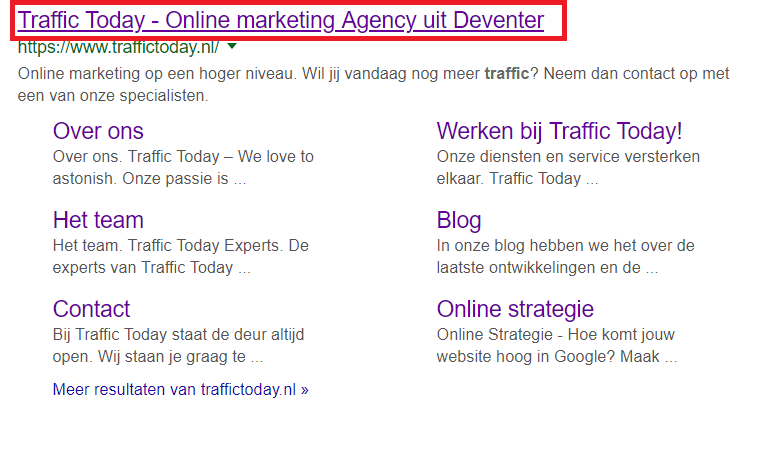
As well as using the page’s keyword and your brand name in the title, there are also a number of other words that can help drive more traffic. These include:
1. Top
2. Best
3. News
4. Reviews
5. Information
6. Today
7. Quick
8. Easy
But how does this actually work? Here’s the thing. Google ranks pages with a higher CTR more highly.

By using appealing words for visitors, the page will stand out more and visitors will be more likely to click on your meta tag to visit the website. When your page receives more clicks, its ranking in the search results will also improve, as Google values a high CTR.
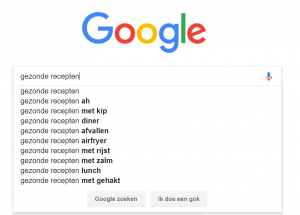
When you enter a specific keyword into Google’s search engine, ‘keywords related to…’ appear at the bottom of the page.
This is the section of the page where Google displays search queries similar to yours to help you improve or refine your search. These search terms can help with website optimisation, as they may also be relevant to you. Don’t forget that these search terms come directly from Google and are therefore excellent long-tail keywords.
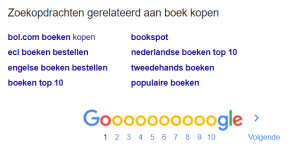
When you search for a keyword on Google, you get a useful list of keyword ideas.
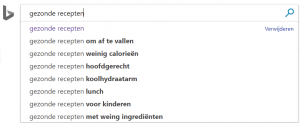
If you do the same for, say, Bing, you’ll end up with a useful list of various long-tail keywords that can be used to optimise the website.
In the first point, we explained how a higher CTR can contribute to higher rankings on Google. We would now like to explain how best to achieve this. Google Ads is the way to a higher CTR. Google Ads also uses a click-through rate. This is therefore one of the factors in improving the quality score of your adverts. When an advert has a higher CTR, CPCs can be lower, meaning you pay less per click.

All the adverts you’ll see on Google are optimised to attract as many clicks as possible. These adverts are therefore the perfect example to use when optimising the meta title and meta description. For example, search for the keyword ‘buy a sofa’. You’ll see adverts appearing at the top and bottom of the page.
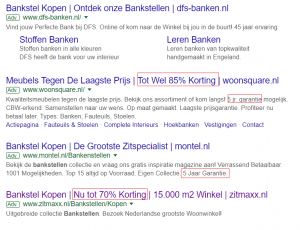
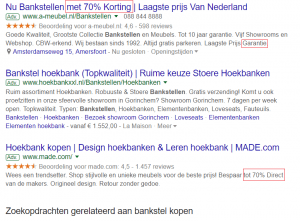
These adverts show that discounts and guarantees are the main selling points. Add these terms to the title tag and the CTR is likely to increase.
Have you ever come across lists featuring the top 10 apps from the past month? Or a list of the top 10 fitness exercises for your abs? These kinds of lists are known as ‘round-ups’. People love lists. If you have the perfect article or product that fits into such a list, be sure to get in touch with the list’s creators! There’s a good chance you’ll be included. What’s more, link building is still an absolute must for anyone who wants to rank highly on Google. The big downside of backlinks is that they’re very expensive and take a lot of time to build up. Submitting your content to a round-up costs nothing and immediately counts as a high-quality and completely legitimate link in Google’s eyes.
Google is getting smarter every year at detecting poor-quality links, whilst it has recently reiterated that links are still one of the three most important ranking factors. The other two factors are content and relevance.
Link round-ups are a great way to tick off one of the ranking factors straight away.
For example:

Every week, Nu.nl compiles a list of the best apps of the week.
If you’ve created a brilliant app, you can give the editors at Nu.nl a nudge to get your app included. And who wouldn’t want a link from the editorial team of one of the Netherlands’ biggest websites?
For very specific and abstract search terms, Google has come up with something brilliant: Search Operators. With Search Operators, you can specify exact keywords that must appear in the results. But that’s not all: you can search for specific file types such as .pdf, words that must appear in URLs, and much more. There are dozens of different Search Operators.
When searching for ‘Round Ups’, you can make excellent use of search operators.
For example:
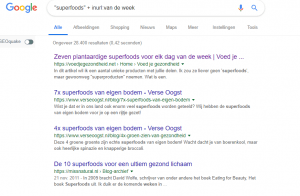
With search terms like these, you can be sure you’ll find plenty of lists. Here’s an example. Let’s say you run a shop selling healthy products. We search for the keyword ‘Superfoods + This week’. We use a search operator and, lo and behold, countless lists full of superfoods from brilliant websites. Surely you must be on one of them?
So how do you approach an editor? The author’s name is often listed alongside the article. If there’s no email address provided, try finding them on LinkedIn or email the website’s general address. Make sure you include a compliment about the site in your email, so that the site owner is more inclined to add your link.
This tactic is similar to compiling ‘Round-Ups’, with the key difference being that these links are to permanent pages. You often see phrases such as: ‘For more information – click here.’ Or, for example, you might see a list of links relevant to the website on which they appear. Perfect! You want to be included here, and the best part is that you already know the site is willing to include links to other sites provided the content is a good fit. So, if you’ve written a brilliant piece of content that ties in perfectly with this topic, make sure you get in touch with the site owner. Here’s an example:
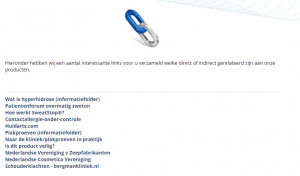
On this page belonging to a cosmetics manufacturer, there are all sorts of links to other sites related to its product. You can find lists like this in every industry! All you need to do is ensure your content is good enough to convince the site owners. How do you find these sites? Fortunately, you can do so in the same way as finding ‘Round-Ups’: using search operators. Once you’ve found a list of sites, there are standard, easy-to-use templates you can send out. Here’s an example:
Dear [Name],
Today I was looking for information related to [Your topic] when I came across your page with useful links.
Very helpful!
I really appreciate that [Write something unique about his/her website or links page].
Personally, I have also recently written an article on [Your topic].
Perhaps this would be a good addition to your list!
I’d love to hear from you, and thank you in advance!
This approach to link building works everywhere, so certainly not just in the Netherlands. Do you have an international website and would you like to do more in terms of international link building and international SEO? Please do get in touch with us!
In Google’s eyes, the Netherlands is just a small country. SEO works differently in every country. When searching online for SEO tips, you’ll mainly come across major American blogs such as Moz and Ahrefs. However, SEO works slightly differently in the Netherlands. Because the American market is much larger, there is automatically more competition and it takes more effort to secure that coveted number one spot. Whilst in the US you need to write thousands of words of excellent content to rank among the top results, in the Netherlands far fewer words are required. However, whilst the content may not need to be quite as long, it must be of a very high quality. Internet users very rarely read all the text on a page, even though you might think it’s useful! In the Netherlands, we therefore recommend writing SEO texts of no more than 1,000 words that answer all potential questions about your product or service.
Google is becoming ever smarter. For a number of years now, Google has been using ‘RankBrain’, a programme that uses artificial intelligence to analyse search results. With RankBrain, relevance and the user’s intent are of paramount importance.
Imagine this: you’re going to write an informative piece about your product or service. Put yourself in your customers’ shoes and draw up a list of all the questions they might have, then write a short, concise answer to each one that leaves no room for misinterpretation. Explain everything without beating about the bush. Not only will your content become more useful and rank better, but you might even land that prime spot on Google: the featured snippet. The featured snippet is a box at the top of the page that displays additional information about the search term entered. The featured snippet usually contains a small image, around 60 words of text and a link to a website. See the example below.
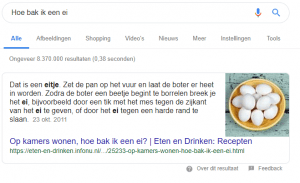
Featured snippets usually appear in response to short queries. Typical queries consist of 3 to 6 words and usually begin with ‘What’, ‘Why’ or ‘How’. Implementing a featured snippet requires a small amount of code (schema.org) but, above all, high-quality content. Even if as many as six different sites have added the code for a featured snippet to their pages, Google will still decide for itself which one is actually displayed. Featured snippets and other Schema.org code can customise the way you appear in search results in all sorts of ways. Our technical SEO experts can certainly help you with that! A more attractive layout for your website in Google will definitely lead to a higher CTR.
The most competitive search terms in the Netherlands – particularly now, as the year draws to a close – are terms such as ‘health insurance’, ‘car insurance’ and ‘switching providers’. Such search terms have a search volume of around 100,000 per month in the Netherlands, spread throughout the year. In December, that figure triples. Such a high search volume also immediately suggests just how incredibly competitive the insurance sector is. Just think about how many insurers there are. They all want that number one position. But of course, that’s not possible. What you see now, for example, when people Google ‘best health insurance 2019’, is that pages filled almost exclusively with text rank highly. These texts provide appropriate answers to a number of frequently asked questions, supplemented by a few links where you can read a more detailed answer. High-quality content combined with links will therefore definitely take you right to the top of Google!
You may well have noticed this already. Every so often, new features are added to Google’s search results. A few years ago, for instance, we had the ‘featured snippets’, which we discussed in the previous point. Recently, Google has become better at recognising information that is linked together. For example, when you Google a well-known person, you immediately get all sorts of related information about that person. Let’s take George Clooney as an example.
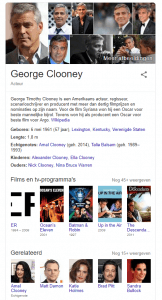
We immediately see a brief description of the person from Wikipedia, personal details, the films in which he has appeared, and related individuals such as his wife and other actors with whom he has frequently appeared. Recognising related information is directly linked to user intent. You Google ‘George Clooney’, which signals to Google that your intention is to find out more about this person.
The same applies to news stories. When we Google a topical news story, such as the ‘stint’, you’ll immediately see the news right at the top:
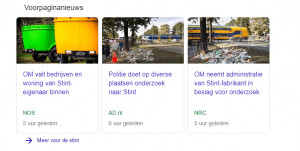
This is because you wanted to know more about the stint.
Research has shown that these special listings appear almost exclusively when there is a lot of competition for a keyword or when the keyword is highly topical. For the average Google user, all these new features are very useful. You can see exactly what you want straight away: more information about the topic you’re searching for. However, for online marketers and website owners, it is important to realise that all these features are taking clicks away from the standard search results. In fact, these special features usually replace the #1 position, which accounts for up to 70 per cent of all traffic. You should therefore ask yourself whether you really want to target keywords that are dominated by these special listings.
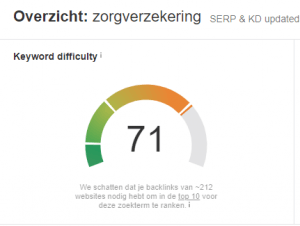
Earlier, we briefly mentioned the highly competitive keyword ‘health insurance’. Unsurprisingly, this keyword also scores very highly in terms of difficulty. To move from the third page to the first, it will cost you an estimated 212 backlinks. Let alone the top spot!
Data shows that pages with at least one image attract up to 94 per cent more traffic than pages without media. Media can consist of images, videos and other interactive content. However, what works best are eye-catching infographics. Good infographics tell a logical, easy-to-follow story to explain a complex concept. What’s more, people do take in the information from these graphics, unlike text! So you’re also helping your users a great deal, which in turn can lead to conversions. Media is therefore definitely the way to go. The more relevant, the better!
In this blog, we’ve listed 8 hacks that can help you further with SEO, but there are actually 100! If you’d like help in further developing your SEO campaigns, Traffic Today will be happy to assist you. Get in touch today for a no-obligation chat and discover the possibilities.




Our team is
ready to help you

