Proud partner

Proud partner
Article
Summary


Do you want to gain a better understanding of your target audience? And do you want to tailor your content accordingly? Creating a persona gives your target audience a face and enables you to put yourself in their shoes more effectively. For a small, specific target audience, you can often create a single persona. However, if your target audience is very broad, you’ll need to create more than one persona to gain a valuable overview. Read on to find out how to go about this and what you can do next to use your personas successfully!
A persona is a fictional profile that represents your ideal target audience. It includes detailed information such as age, behaviour and areas of interest. This tool helps you understand what your potential target audience needs. With effective personas, you can empathise with different target audiences, resulting in a better understanding of their needs and expectations. Using personas helps in designing products and services that cater to the diversity of your audience. Creating well-researched personas is crucial for successfully understanding and engaging with your target audience, helps build lasting relationships and enables you to establish segmentation criteria.
In fact, a persona can be seen as a sort of CV for your target audience: who is this target audience? What are their interests and needs? What roles do they hold? And how do they behave? These are just some of the questions that can be asked when creating a persona. You can create a persona for both B2C and B2B target audiences. It’s best to follow a step-by-step plan, in which you work out the various characteristics of the target audience. Make sure you don’t just rely on your own gut feeling, but actually survey your target audience. This way, you can find out what the target audience needs and how you can reach them more effectively. After all, the target audience knows best what they want.
As well as surveying your target audience, there are a number of other steps you can take when creating a persona. For example, you can already extract a great deal of information about your target audience from Google Analytics. Carry out keyword research to find out what your target audience is looking for, and check whether there are any relevant groups on social media or LinkedIn that relate to your business. All of this tells you more about who your target audience is and how they behave. When creating a persona, this helps you form an initial impression. Make sure you present the information you’ve gathered in a visually appealing and clear way, so that your persona is easy to understand at a glance.
There is a difference between creating a buyer persona and creating a user persona. Whilst the buyer persona describes an ideal client, the user persona describes who uses a particular product or service. A user persona is used, for example, to map out online behaviour and preferences and to tailor the website accordingly. The information in this persona relates to the person behind the customer. The buyer persona, on the other hand, focuses primarily on the purchasing habits of your target audience, in order to reflect their buying behaviour.
There are various templates available that describe how to go about creating a persona. Depending on your target audience and the purpose of creating the persona, one template may be more suitable than another. In the following overview, however, we have tried to summarise the key steps for you, so that the process of creating a persona becomes clearer.
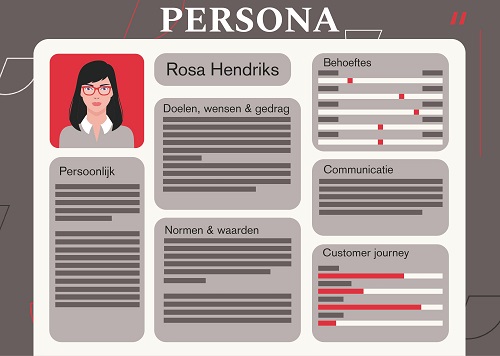
A persona named Rosa or Piet will come to life much more than if you simply call your persona ‘persona 1’.
Delve deeper and identify characteristics of the persona, such as gender, age, education/level of thinking, hobbies, interests and use of social media platforms. This is particularly important for B2C companies. For B2B companies, it is important to answer questions such as: what role does the person play within the organisation? What are their responsibilities and tasks? How does the person feel about their work? What is important to them? – The more information you provide here, the clearer a picture you will get of the target audience and the easier it will be to cater to their needs.
Why does your persona decide to buy your products? What requirements are placed on the product and the information about it? How much money do they spend on average? How often does your persona buy your products?
What beliefs drive your persona’s behaviour? What are their core values? On what basis do they form their opinions? Which media, people, information, etc. influence the persona’s actions?
What are your personas’ needs? Also consider ordering methods, delivery times, product information, payment options, etc. What ‘pains’ and ‘gains’ does your persona have? Don’t forget your target audience’s concerns either: are they worried about, for example, quality, price, reliability, …?
What tone of voice should you use for your persona? Should you use ‘u’ or ‘jij’ when addressing them? Do your personas need detailed information, or are the main points enough? Would they prefer more text or more visuals?
What does your persona’s customer journey look like? Through which channels do they move from research to purchase and after-sales service? Via which devices (desktop, phone, tablet)? Who else plays a role in the decision-making process – in other words, who is consulted for advice when making a purchase?
Now that you know everything about your persona and have a clear picture of who they are, the final step in creating your persona is to give them a face, using an illustration or photograph. This makes your persona feel more realistic, just as the name does.
Now that you have a better understanding of what a persona is and what information might be important within it, you may be wondering how you can put this into practice. We’re going to tell you that now. You can use personas for various purposes. For example, by knowing which channels your target audience regularly uses, you can focus extra attention on these. Does your target audience spend all day on TikTok? Then you might consider creating TikTok videos to attract their attention. Have you discovered that your target audience hardly uses Facebook at all? Then this isn’t the right platform for you to put a lot of effort into. Creating personas can therefore help you identify the right platforms.
It is also possible to use the information from the personas provided for the content on your website and in your adverts. Does your target audience place a high value on reliability before purchasing a product like yours? If so, you can provide more information about the quality of your product and demonstrate that your product and service are trustworthy. You can personalise your content further by tailoring it to your target audience(s). This will make them feel more engaged and encourage them to make a purchase more quickly.
It may seem like a good idea to map out your target audience using personas, but this takes work, and it would be a shame if creating those personas had been for nothing. Simply knowing which personas your target audience comprises doesn’t automatically mean they’re actually being used. Unfortunately, they often end up in the bin or at the bottom of the pile. That’s why we’re telling you here how to ensure that the personas are actually put to use.
First and foremost, it is important to be clear in advance about what you intend to use the personas for. The personas may be of interest to several departments. By establishing clarity on this in advance, you can create a persona based on all the expectations and needs of the various departments. Are the personas finished? Then make sure everyone gets to see them and is told about them. Make them visual and print them out. You can display them in various places around the company so that the right people see them regularly. That way, at least, they won’t be forgotten. Also, be enthusiastic and demonstrate that it can work, as well as how to use them, so that creating personas is not only fun but also valuable.
Finally, we’d like to point out a few pitfalls so that you can avoid them. It is important not to focus on just one particular client, but to gain as broad an overview as possible and to group the different types of clients together when creating the persona. Are they too different from one another? If so, create multiple personas to avoid focusing too much on any one type of client. Furthermore, it’s important to dig deeper and not remain on the surface when creating personas. It’s precisely by delving deeper that you’ll understand your target audience much better! Don’t forget that there may also be a group that doesn’t fit directly into your personas but is still part of your audience: you need to bear these people in mind too.
Name: Mark Jansen
Who/What he is: Mark is an experienced software developer aged 35. He has been working in the IT sector for 10 years and has worked on various projects, ranging from mobile apps to complex business applications. He is known for his in-depth technical knowledge and creative approach to problem-solving.
Demographic details: Male, aged 35, living in Amsterdam, the Netherlands.
Aspirations and goals: Mark strives to continually improve his programming skills and keep up to date with the latest technologies. He wants to tackle challenging projects that test his technical expertise and give him the opportunity to create innovative solutions.
Concerns and frustrations: Mark is concerned about the rapidly changing technological landscape and the fact that some companies are not embracing the latest technologies. He is frustrated by poorly written code and a lack of documentation in the projects he works on.
Quote/Tone of Voice: “Every line of code is an opportunity to create something amazing. Let’s do it right.”
Appearance: Mark has a trendy and casual style. He often wears T-shirts with funny programming-related prints and comfortable jeans. His dark hair is cut short and he has a well-groomed beard.
Do you still have any questions about creating personas after reading our blog? Please feel free to get in touch with us. We’d be happy to help and give you tips on creating your ideal persona.




Our team is
ready to help you

