Proud partner

Proud partner
Article


The possibilities for approaching clients personally with personalised messages are becoming increasingly sophisticated. A wealth of opportunities awaits every online shop. In this article, I’ll tell you more about this and highlight a number of personalisation examples. Hopefully, these examples will inspire you. (reading time: 3 mins)
From the list of personalisation examples, let’s start straight away with an interesting one. We’re talking about the ability to send automatically personalised emails. If you run an online shop with thousands of ‘regular’ customers, sending a separate email to each one would be an impossible task. As a result, businesses often rely on a newsletter where the entire target audience receives the same email. This is not personalised and therefore reduces the likelihood of conversion.
Within triggered emails, you have the option to create triggers, so that the software then automatically sends out emails. There are various options available here.
Because you can fully integrate and customise these triggered emails yourself, you also have the option to configure them in the way you think is best for your customers. Consider the timing (how often, after how long, etc.) at which these emails are sent, as well as the specific time at which they are sent.
You’ve probably seen them on an online shop: ‘Your recently viewed products’. These show the products you’ve most recently viewed on that particular online shop. Handy, but they don’t help you explore similar or better options. With personalised product recommendations, you do get these options.
Of course, you can choose to show your customers the same ‘recently viewed’ products. However, there is also the option to automate upselling and cross-selling based on data. This means you no longer have to add these manually, and you no longer have to spend hours on it whenever the product range changes. Every online shop purchase is ‘stored’ in JavaScript, and products are automatically displayed for upselling and cross-selling based on all that data.
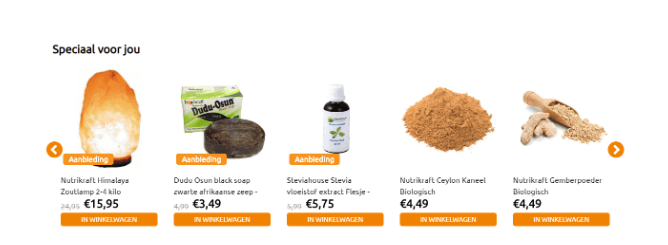
In addition, you have the option to display your best-selling products for a specific client based on data. Imagine that a client frequently searches for and views LED dimmers; in that case, LED dimmers will be displayed, with the ‘best-selling’ product appearing first.
In addition to these capabilities, you also have the option to encourage shopping basket purchases (such as ‘checkout bargains’) with personalised products and to top up a shopping basket (encouraging free delivery) with products that are relevant to the customer.
A final example of personalisation is the use of a personalised search function in the online shop. This makes it possible to immediately display products that the customer has most recently viewed or, based on data, those that are of most interest to the customer. By customising this setting, each visitor will therefore see different results for the same search query.
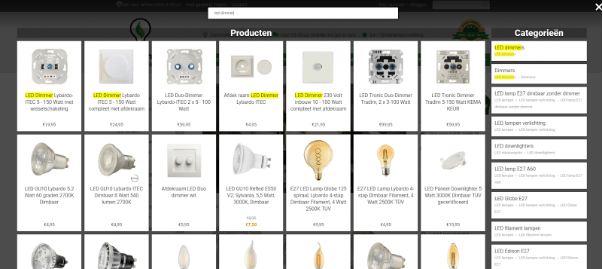
In addition to the personalisation examples mentioned above, there are even more ways to personalise your online shop. This often involves using a software programme that handles and monitors this for you. This means you only need to keep a casual eye on things now and then; the software takes care of the rest for you. Of course, you can adjust and optimise this as often and as you wish, but even if you don’t, thanks to machine learning, it gets a little better every day.
By making your online shop a little more personalised every day, your customers will feel supported more quickly and become more engaged. In our experience, this ultimately leads to a higher conversion rate and higher order values (thanks to data-driven cross-selling). We certainly see the potential here. When are you going to start making your online shop more personalised?




Our team is
ready to help you

