Proud partner

Proud partner
Article


Do you often quickly skim through the product description before buying something? If so, you’re certainly not alone. Writing good product descriptions is therefore perhaps one of the most effective – yet most overlooked – tools in your marketing arsenal. Although eye-catching photography and a fast, well-organised website work in your favour, you won’t achieve the best possible results if you neglect your product descriptions. It’s a quick win, then. Read on to find out how to go about it and what to look out for when writing a product description.
Every product in an online shop has its own unique product page. Via this page, visitors can add the relevant product to their shopping basket. However, this is only the final step in the process that takes place on the product page. Additional factors such as photography, stock levels, specifications and – indeed – the product description all influence a customer’s decision on whether or not to proceed with a purchase. This is reason enough, therefore, to optimise every factor in this decision-making process as effectively as possible.
The product description is a text on the product page that briefly explains what the product is, what its benefits are, how it should be used and what its unique features are. This puts the product into context and helps a visitor better identify with the customer’s needs regarding this specific product. You can approach a product description however you like; for example, use a fresh tone of voice with plenty of bullet points to keep the text easy to scan, or ensure you tell an intriguing story in which the product plays the leading role. Anything goes – but do make sure to tailor the text to the product.
Although you may be fully familiar with the products in your online shop, visitors to your website probably aren’t yet. For them, it’s important to find out more about the product they’re interested in. So make sure you include this information on your product page to prevent visitors from looking for it elsewhere.
However long or short you wish to make a product description, certain factors must always be included. Naturally, you should list all relevant product specifications. Specifications include, for example, things such as materials, ingredients, dimensions – you name it – all information that a visitor can use when making a decision. A short story that appeals to your visitor’s emotions can also add significant value to your product description. This allows you to visualise the everyday use of your product in the life of a potential buyer. Let your audience imagine how your product will impact their lives.
To make writing a product description as easy as possible, we’ve put together a few tips for you. By carefully applying these tips to your product descriptions, you can be sure that you’re covering all the key elements and providing your audience with relevant and compelling information.
Before you start writing, it can be useful to first draw up a list of the product’s USPs. Which features are definitely worth mentioning and should therefore undoubtedly be included in your product description? Are you receiving the product from a supplier? If so, make sure you read up on it thoroughly. Any information you find on the packaging or on the supplier’s website regarding this specific product may also be relevant to you. In short, know what you’re selling and ensure that this information forms the basis of your product description.
Now that you have gathered all the relevant information about the product, it is important to keep your target audience in mind whilst writing. Do you address the visitor formally with ‘you’ or stick to an informal ‘you’? Is there scope for a scenario in which the product comes in handy? And if so, which scenario best suits your target audience? These questions will help you make choices during the writing process. By adapting your writing style and choice of language to your target audience, you increase the likelihood that visitors will actually become enthusiastic about the product.
There’s a good chance that visitors will still have a few questions when they see your product page. The product description is the perfect place to address some of these questions. In this way, you lower the barrier to entry and turn consideration into a purchase. For example, you could choose to include answers to frequently asked questions about the product within your text, or you could take a direct approach and list all the questions verbatim, alongside a specific answer.
As mentioned earlier in this blog, it is important to tap into the emotions of your target audience. Make sure a visitor can imagine what life would be like after purchasing this product. What possibilities would arise? For example, by sketching out a scenario in which the product plays the leading role and offers a solution to all sorts of problems, you help the visitor to picture this in their own life.
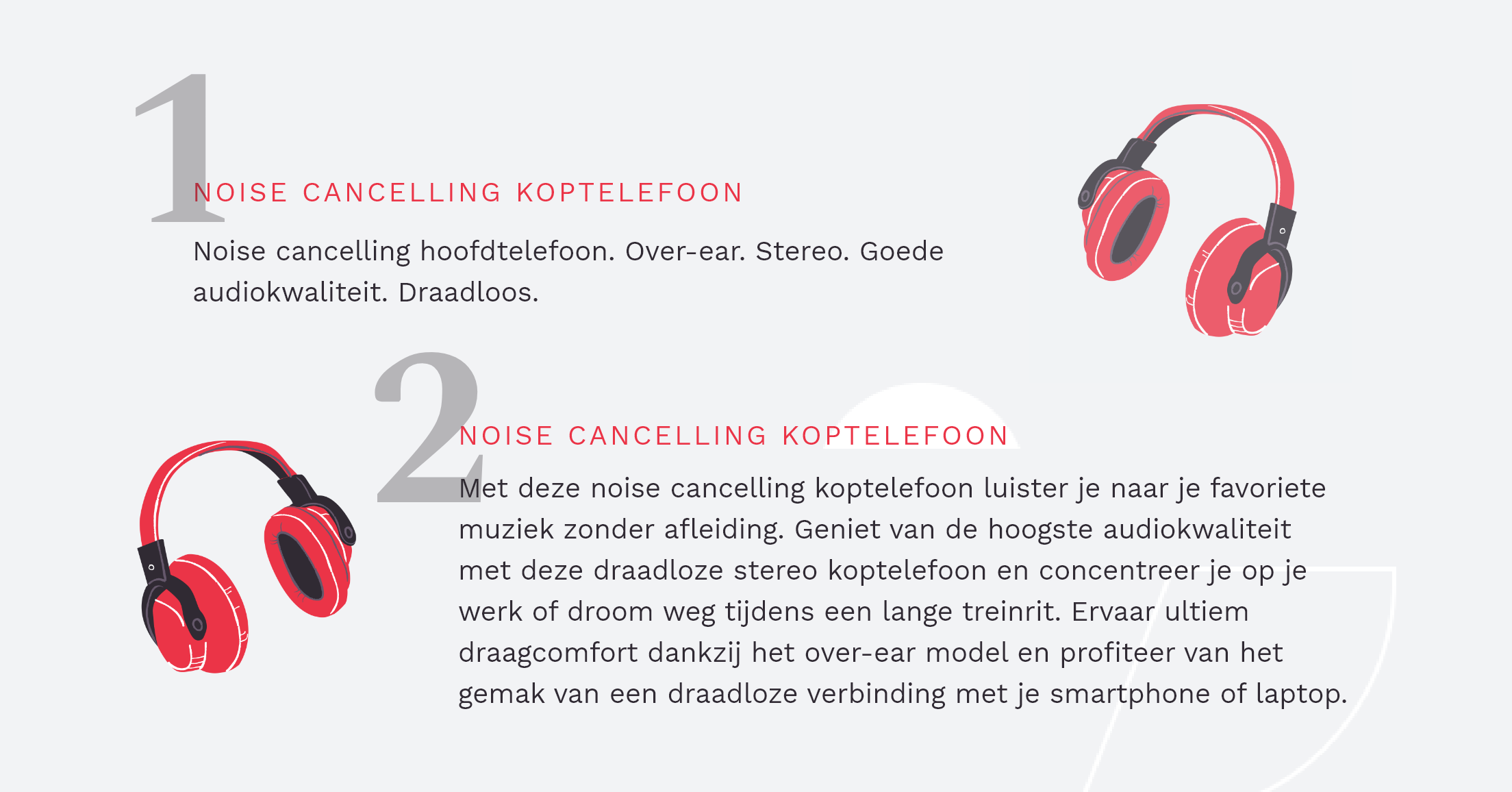
To illustrate: suppose you sell noise-cancelling headphones. Here are two ways to frame your product description. The first example is mainly factual. The second example appeals to emotion. Which product description would yield the best results?
Of course, a fictional story designed to appeal to emotions is a good start, but to really give your description weight, you need existing clients. Clients who have previously purchased your product and are happy with it are the best advertisement you can have. You should therefore use these experiences strategically when a new visitor is considering a purchase. The social proof provided by reviews or the experiences of others can be the deciding factor.
By ‘product description’, we mainly mean text. However, the way in which you present this text can certainly vary. For example, a flowing narrative with full sentences can be effectively interspersed with a few bullet points listing a product’s USPs. You can also use visual elements such as ticks, plus signs or stars. The combination that ultimately emerges is what convinces a visitor to make a purchase.
Of course, you write a product description first and foremost for your visitor. However, it is also strongly advisable to take into account the preferences and requirements of a search engine. The product description is of great importance for the search engine optimisation of your online shop. After all, do you want your specific product to feature prominently in the results for a particular search query? If so, it is essential that you use the right keywords in your description.
Google is, of course, by far the largest search engine and therefore often the most relevant for ensuring your online shop features prominently in search results. By incorporating various factors into your product descriptions, you increase the likelihood that Google will pick them up and display them in a prominent position for relevant search queries.
Make your product descriptions part of your marketing strategy and ensure that consideration turns into a purchase. Help visitors to your website make a choice by providing clear and honest product descriptions for every product. With a little attention to your copy, you’ll achieve results quickly.
Don’t have the time to write your own product descriptions, or lack the necessary in-house expertise? Then outsource the work to Traffic Today. Our specialists take every factor into account and ensure optimised descriptions that satisfy both your visitors and the search engines. We’d be happy to tell you more!




Our team is
ready to help you

