Proud partner

Proud partner
Article


A fine of no less than 2.42 billion euros. This was to be imposed on Google by the EU in June 2017. The reason? In its search results, the search engine was alleged to have given its own price comparison service, Google Shopping , priority over the competition. In other words: an improper abuse of power. This led to the introduction of Comparison Shopping Services (CSS).
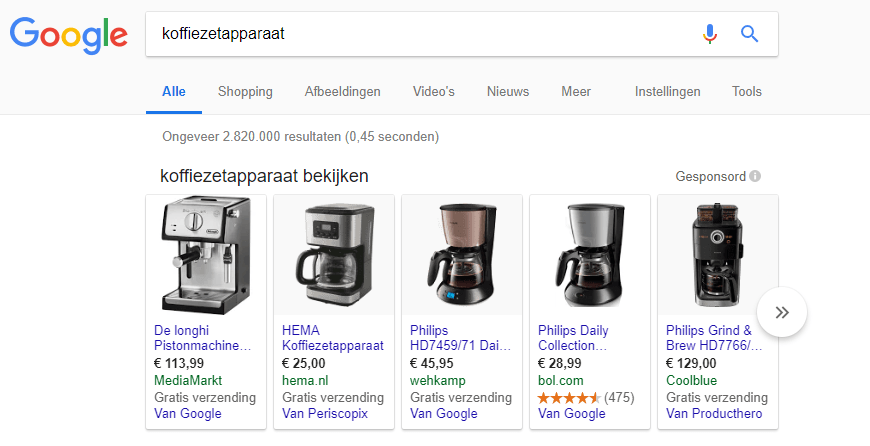
Advertisers can, as before, purchase product adverts in Google’s SERPs. This is possible via Google’ Shopping, but you can also do so through other price comparison sites, such as Beslist.nl. Below each product is a link to the CSS partner, which makes it clear for the consumer. If the product is clicked on, the user is taken directly to the advertiser. It looks like this:
Advertising slots for a product are sold via an auction, just as with other Google Search adverts. Placement is determined based on the bid in combination with the expected CTR. This also determines your CPC. In Europe, this CPC is now split: on the one hand, the CPC you pay to Google; on the other, a margin for Google Shopping. This is estimated at 20 per cent. If you choose to advertise via a CSS partner, the 20 per cent margin for Google Shopping is waived. For advertisers, this means a 20 per cent reduction in advertising costs, or you can maintain your effective CPCs at the same level to achieve greater visibility and conversions.
The Google Shopping landscape was turned on its head when the new partner programme was launched. Why exactly? If, as an online shop, you publish your product listings via a CSS partner, you can count on a substantial financial benefit. In addition to the 20 per cent margin, a percentage of the click costs you incur is refunded to your AdWords account as advertising credit. This can amount to a maximum of €32,000 per 30 days. Please note, however, that this incentive is likely to be temporary.
Let’s not beat about the bush: that financial discount is the biggest advantage. The 20 per cent margin is normally included in the auction. This means that a bid not placed via CSS is 20 per cent lower than the actual bid: 80 per cent of it goes into the auction and 20 per cent goes directly to Google. If a Merchant Centre is connected via a CSS, the full bid is included in the auction.
However, it is not all plain sailing. There are also a number of drawbacks to mention. If you migrate an existing Merchant Centre, Google will no longer provide a contact person for the AdWords account. The existing contact persons will lose access to the account. One option is to set up Google Shopping campaigns in a new AdWords account, but in terms of campaign history, this is often not ideal. Another drawback is that other CSS partners are no longer visible in the Merchant Centre. You can resolve this by creating a new AdWords account.
Google openly states that this is a temporary promotion. The aim is to attract more price comparison sites to Google Shopping . So is Google CSS only of interest to so-called early adopters? No, although it is true that you stand to gain more if you get on board sooner. Advertisers who choose to advertise exclusively via Google Shopping will continue to pay 20 per cent more for product listings in Google Search compared to their competitors.
So should everyone switch to CSS? No; our advice is to duplicate existing campaigns and run them side by side, each with its own bidding strategy. It is important not to lose sight of the bigger picture. Be sharp and bid smartly. It’s important to bear this in mind if you want a healthy Return on Advertising Spend (ROAS). Here at Traffic Today , we’re working hard on these developments. Would you like to know more about Google CSS, or are you curious about the possibilities for your business? Feel free to call or email us.




Our team is
ready to help you

