Proud partner

Proud partner
Article


Since the rise of marketplaces such as Bol.com and Marktplaats, the popularity of these online sales platforms has shown no sign of waning. In fact, with the launch of Amazon.nl on the Dutch market, marketplaces are more important than ever! Marketplaces have therefore become a key part of the marketing landscape – particularly for e-commerce businesses aiming for rapid growth.
In this blog, we explain exactly what a marketplace is, what the trends are in this area, and how you can capitalise on them to achieve rapid growth.
A marketplace is an external online platform where, as an entrepreneur, you can sell products. Examples of marketplaces with a strong position in the Netherlands include Bol.com, Marktplaats and Amazon, as well as Fonq, Blokker and Wehkamp. A marketplace may, for example, focus on a specific product group such as furniture, but it may also be all-encompassing and offer a platform for virtually every conceivable product. Every marketplace has its own advantages and disadvantages, rules and terms and conditions that apply to the sale of products via that particular platform.
Many entrepreneurs choose to offer their products via an online marketplace – or even several – in addition to their own online shop. The benefits of this approach include:
When shops were forced to close their doors en masse to the public in 2020 due to the coronavirus pandemic, that same public flocked in large numbers to online marketplaces. Products that would normally be purchased in physical shops suddenly had to be bought online. Marketplaces emerged as the big winners in this situation and saw their turnover skyrocket. But what does this mean for the future? Will the success of marketplaces continue, or will a return to high streets lead to a significant decline in online shoppers?
It remains, of course, a matter of speculation, but we can now say with some certainty that the impact of marketplaces on the online sale and marketing of products is here to stay. Consumer behaviour has changed, partly due to the simplicity offered by marketplaces; buyers are never more than a few clicks away from their next purchase. The fact that delivery is usually lightning-fast only lowers the barrier to entry even further!
What’s more, marketplaces provide the overview that consumers are looking for. You can easily compare products from various brands and don’t have to trawl through dozens of online shops in search of the best deal. So, as a business, making your products stand out on marketplaces can certainly be a smart strategy for generating more conversions.
Trends you should definitely keep an eye on in the coming years include:
Anyone who still thinks that consumers search for products on their phones and then make the actual purchase via a desktop computer is in for a surprise. Since 2016, the share of mobile shopping has risen by over 20 per cent from 52 per cent to as much as 73 per cent in 2021. This means that nearly three-quarters of all shoppers prefer to make purchases via their mobile phones. A marketplace that has its mobile interface in order, or even employs a mobile-first design, is likely to achieve significantly better results than an alternative without a mobile-friendly interface.
The chances of you winning the battle against giants such as Bol.com or Amazon are very slim. These established names are so dominant within the market that start-up marketplaces simply cannot compete with them. These marketplaces offer a very wide range of products and are therefore horizontally oriented. A vertical marketplace focuses on a specific niche – and there is still plenty of room in the market for this type of online marketplace! For example, if your business specialises in outdoor products, such as camping gear or travel bottles, look for a marketplace that specifically targets travellers.
The largest AI implementation within e-commerce is the chatbot. This software ensures that customers can be assisted 24/7 with the (standard) queries they encounter. The technology has not stood still in recent years, and chatbots are consequently becoming increasingly sophisticated. This ensures an optimal customer experience, with the focus primarily on a customer-first approach. However, ‘ Artificial Intelligence ’ within e-commerce and marketplaces is not limited to chatbots; features such as personalised recommendations based on shopping history and the analysis of the best sales channels are also achieved using this technology.
With the rise of online wallets such as Apple Pay and Google Pay, the need for complementary payment methods is increasing. To make things as easy as possible for consumers, as a marketplace you’ll want to tailor the payment process to buyers’ preferences. Post-payment options such as Klarna are also gaining in popularity. As a business owner, it may therefore be wise to select a partner marketplace that offers a sufficient range of payment options.
Omnichannel sales mean that the sales process takes place across various channels. This makes the experience as seamless as possible and ensures greater loyalty among visitors who actually go on to make a purchase. Furthermore, this approach allows a marketplace to remain top of mind; adverts and updates are displayed across different channels, ensuring customers are constantly reminded of it.
Did you know that you can now embed product links in videos? When clients watch video adverts and see a product that appeals to them, they can click on it straight away if there’s a link behind it. This way, you turn video not only into an inspiring medium but also into a way to generate actual sales. A number of e-commerce brands are already making use of this – thereby providing a fully-fledged shopping experience.
Consumers are becoming more aware. This means that choices are being made differently and brands can no longer get away with a half-baked vision for the future. Issues such as carbon offsetting for an order, sustainable packaging and a brand manifesto focused on the future are no longer optional. Because marketplaces have such a significant impact on the environment – with the non-stop logistical flow of parcel delivery drivers – the platforms certainly have something to make up for. Do you, as an entrepreneur, also consider this important? If so, be sure to find a partner who shares these values.
As mentioned earlier, AI is set to play a greater role in e-commerce and, consequently, in marketplaces. Personalisation options are a prime example of this. As well as providing information tailored to visitors’ behaviour, AI also offers the possibility of providing truly personalised products that visitors can put together using a configurator. Water bottles, phone cases, shoes – everything can be printed to your liking. How personalised do you want it to be?
With the advent of smart home assistants and searches carried out via voice commands, consumer search behaviour is changing. Whilst concise keywords in Google were once the primary means of searching, full questions posed to Siri, Alexa or Google Home have now become firmly established. This makes FAQs on a website particularly valuable – as the full question is written out there and the answer is displayed immediately. A marketplace that is also optimised for smart assistants therefore has a greater chance of emerging as the preferred platform in light of current developments.
The nature of online marketplaces is, of course, primarily digital, but an increasing number of platforms are choosing to open pop-up shops so that they also have a presence on the high street. Brands that previously operated entirely online can now also be visited as physical shops. This creates a seamless customer experience, where products can be viewed offline and purchased online – and vice versa.
As an entrepreneur, you naturally want your products to reach as wide an audience as possible within your target group. A marketplace can contribute significantly to this. The benefits mentioned earlier in this blog often outweigh the additional costs involved in partnering with an online marketplace.
Once you’ve got your own online shop up and running, the next step towards further growth can sometimes present a further hurdle. Selling your products via a marketplace could be exactly the stepping stone you’re looking for.
Decide whether your business is ready for further growth. If so, choose a partnership that suits you. For example, one marketplace offers the option of taking over your entire fulfilment process, including product storage, whilst another provides only the platform and reach. The choice is yours.
Read our articles on selling via the two largest marketplaces:
Once you have registered as a business partner of a marketplace, you need to upload your products via a manual or automatic feed. With an automated .xml feed, for example, you ensure that the products displayed on the marketplace are refreshed daily and reflect the status of your online shop. As soon as a product is sold out, the online marketplace will no longer display it because the feed is automatically updated.
There are also marketplaces such as Bol.com that use an API (application programming interface). This API provides a direct link between Bol.com and your online shop or feed management tool. This direct link prevents delays and makes it even easier and quicker to sell your products. Did you know, by the way, that 40 per cent of Bol.com’s turnover is generated by external sellers (20,000)?
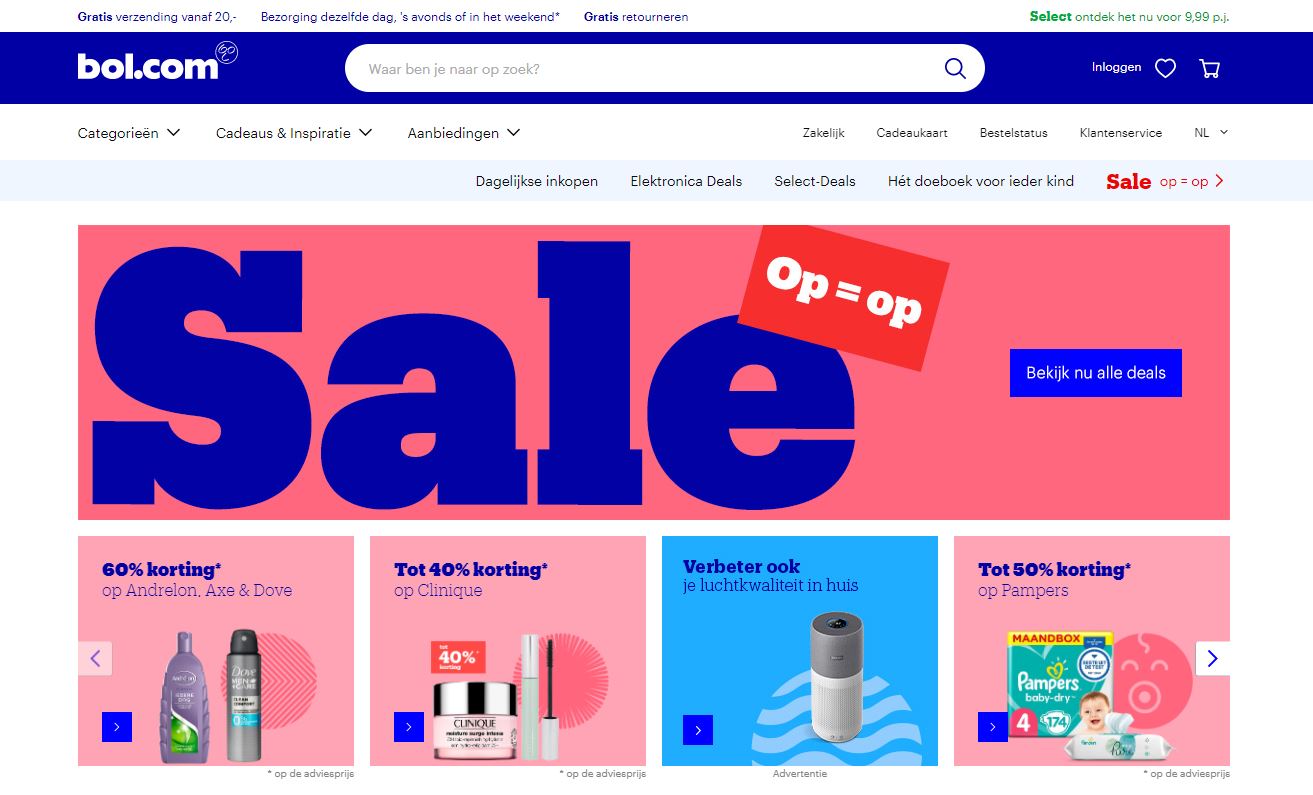
Within a marketplace, one of the most important things is to craft a strong title for your product. In other words, content optimisation. Why? Research has shown that around 20 per cent of marketplace users find a product via the category structure. By clicking on the correct category here, they find the product they are looking for. This also means that 80%(!) of users do so via the marketplace’s search function. You therefore need to ensure your products are visible the moment a visitor starts searching.
For example, do you have a product from an unknown or private label brand with no search volume? In that case, do not mention this brand in the product title, but give the product a generic name that visitors search for.
Naturally, you pay a fee to use a marketplace. For some online shop owners, this is a reason to opt out of a partnership, but for by far the largest group, it is a way of keeping costs under control. After all, you know exactly where you stand with a fixed fee based on a ‘no cure, no pay’ arrangement.
However, as an entrepreneur, you may find that your profit margin is too low. For example, the rules regarding delivery charges may differ from those you apply in your own online shop. If you offer free delivery on orders of €50 or more, but the marketplace requires you to offer free delivery via their platform on orders as low as €20, your profit margin can become quite small. To minimise this, you can set up automatic rules that assess the products from your online shop before they are uploaded to a marketplace. For example, you can specify that products with a profit margin below a certain amount are not displayed. You can also choose to have the price of these products automatically increased by a certain percentage – with the amount rounded up to a round figure or ending in .99 – so that you still increase your profit margin when selling via the marketplace.
However complicated it may sound, there are plenty of tools available to simplify the management of your marketplace feed. For example, there are many different feed management tools that establish links between your online shop and the various marketplaces. In addition to the integration, most tools also offer extra features for customising and optimising your feeds for a specific marketplace.
There are many different data feed management tools available. Some popular ones are:
Traffic Today , for its part, often works with Channable. This tool offers a comprehensive range of integrations and numerous options for customising, configuring and optimising the various product feeds. However, the right tool for you depends on your specific requirements. Here are a few things to bear in mind:
It is no secret that search engines – and Google in particular – earn a considerable amount of money from their advertising programmes. However, marketplaces are becoming increasingly competitive. Many searches now begin on a marketplace, meaning the search engine is bypassed in the search for a product.
Nevertheless, marketplaces still make extensive use of search engine services. Both Search adverts and adverts via Google Shopping form part of marketplaces’ online strategy.
All in all, it’s certainly worth looking into whether there are any relevant marketplaces for your online shop. Given the trends currently emerging, this is the perfect opportunity to generate (more) sales in the (very) short term!
Please feel free to get in touch with us to discuss the possibilities and opportunities. We’d be happy to carry out a no-obligation analysis and provide you with comprehensive advice.




Our team is
ready to help you

