Proud partner

Proud partner
Article
Summary


In today’s digital landscape, efficiency is the key to success. With emerging technologies and algorithms promising to lift the heavy burden of manual advertising from our shoulders, Smart Bidding seems like the ideal solution. But is it really the magic bullet of online advertising? Or is it, more often than not, a mysterious black box that works more often than it doesn’t? Immerse yourself in an enlightening conversation with Google’s algorithm, understand the nuances behind your campaign objectives and discover why it is so essential to know exactly what you’re asking for.
Smart Bidding has long been regarded as the Holy Grail in advertising. In the past, you would invest a lot of time in manually setting and adjusting your bids based on various analyses. Now, advertising tools take this work off your hands. You simply specify your objective and voilà, your campaign is automatically optimised.
Yet I often hear people say: “Smart Bidding doesn’t work!”. But does it really not work, or are you simply using it incorrectly? Let me take you through the story of Smart Bidding so that, from now on, you can decide for yourself how this story ends.
To tailor the results to your needs as much as possible, you must first understand what you can ask of the algorithm – and how the algorithm subsequently responds. The algorithm is smart, but it literally carries out whatever you ask of it. By understanding the effect of your input on the output, you’ll discover a great deal about what happens in between. So let’s have a chat with Google!
Marketer: “Generate the maximum number of clicks.” (maximise clicks)
Google: “Right! I’ll spend your entire budget to get as many clicks as possible. I’ll look for keywords and times that have a low CPC, because then I can generate more clicks .”
Marketer: “Generate the maximum number of conversions for me.” (maximising conversions)
Google: “Got it! I’m going to spend your entire budget to generate as many conversions as possible. To do this, I’ll look at all your conversion actions and simply generate as many conversions as possible. It doesn’t matter to you which ones, as long as there are as many as possible.”
Marketer: “I want you to maximise conversion value.” (maximise conversion value)
Google: “Roger that! I’m going to spend your entire budget to generate as much conversion value as possible. I’m not interested in the number of conversions; I’m only looking at the value they generate. I want as much of that as possible.”
Marketer: “You’re allowed to drive conversions at a target CPA of 30 euros.” (target CPA)
Google: “On it! I’ll be driving conversions at around 30 euros each. If they get too expensive, I won’t run with them. I’ll let you know if I think our budget is too low. Then I’ll tell you that more conversions can be achieved at 30 euros each, but that unfortunately the budget has already run out.”
Marketer: “I want to achieve a target ROAS of 5.” (target ROAS)
Google: “Let’s go! I’ll make sure your conversion value divided by your costs comes out at around 5. I can’t promise I’ll spend your entire budget, as I’m focusing on the return target. If I think we don’t have enough budget – because there’s more to be gained within a ROAS of 5 – I’ll let you know.”
Marketer: “I want to be in first place 90 per cent of the time in the auction.” (target impression share)
Google: “Say no more! I’ll adjust your bids so that you’re in first place 90 per cent of the time for the keywords you’ve told me.”
You’ll notice in the conversations that Google does exactly what you tell it to. So think carefully about what you’re asking. Take the example of optimising conversions. If you use different conversion actions that aren’t all equivalent to one another, the smart algorithm won’t take them into account. Have you set both ‘click on phone number’ and ‘transactions’ as conversion goals? In that case, Google may choose to prioritise generating clicks on the phone number for you if that is easier to achieve.
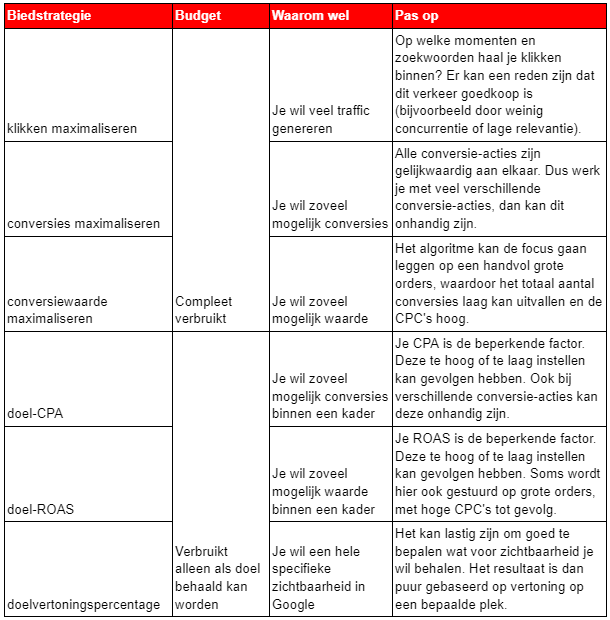
It is also important to understand how Google manages your budget in different scenarios. With maximisation objectives, Google always spends your entire budget. After all, unspent budget represents a missed opportunity to perhaps secure one extra conversion or one more click. With target-based bidding strategies, Google focuses on achieving, well… the target. If 50 per cent of your budget has been spent, but Google believes that spending more would be detrimental to the objective, no further spending will take place. However, Google will notify you that your budget is insufficient once all of it has been spent, even if there are still opportunities to generate more within the parameters you have set.
If you were to summarise this in a diagram, it would look like this:
Now that we know what questions we can ask of Smart Bidding, we must ask ourselves whether it is realistic to make such demands. After all, Smart Bidding relies on historical campaign data to achieve its objectives. If a campaign has never generated a conversion before, is it realistic to say, ‘I want you to start generating conversions now at 30 euros each’? You can always ask, but you shouldn’t be surprised if it doesn’t work out.
We have carried out extensive research ourselves into the number of conversions required within a campaign over a 30-day period to achieve your goals within Smart Bidding. Google itself usually adheres to the rule of 30 conversions in 30 days, but is that true? And is anything above 30 sufficient, or are there still differences to be seen there?
We’ve observed that anything below 20 conversions tends to struggle. More often than not, targets are missed. Once you exceed 20 conversions, most campaigns become more stable. The success rate – the number of times a campaign actually achieves its target – therefore increases significantly. In fact, there is a rise of no less than 36 per cent.
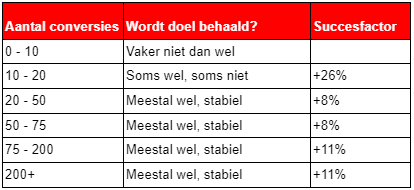
Our research shows that when you manage to achieve more than 200 conversions, the success rate increases by as much as 64 per cent. More conversions therefore generally lead to better and more stable campaigns that consistently meet their targets. However, to work with a target CPA or target ROAS, you really do need between 20 and 50 conversions at campaign level to run the campaign stably. This applies to both lead generation and e-commerce.
Of course, you won’t immediately see 20 to 50 conversions when you launch the campaign. You can then choose to go through the Smart Bidding process:
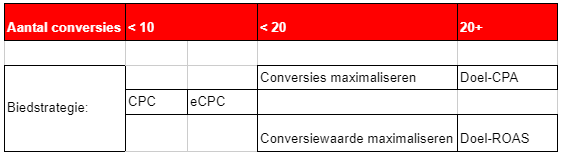
If your campaign is still below 20 conversions per 30 days, you can either start with manual bidding or use a bidding strategy based on conversions or conversion value. Once you exceed the 20-conversion threshold, you can switch to Target CPA or Target ROAS. For ‘Maximise Clicks’ and ‘Target Impression Share’, you do not need to provide any input. You can use these from the start.
It isn’t always easy to achieve 20 conversions. Perhaps you currently have a campaign structure comprising multiple campaigns, each of which generates 5 to 10 conversions individually. This isn’t ideal for Smart Bidding. The first option you might consider is merging data. This can be done in two ways:
If you do not wish to combine campaigns – for example, because they have different objectives – or if you are still not achieving the desired number of conversions even when combining them, you can explore ways to increase the number of conversions. In lead generation, goals are measured as ‘enquiries’ and in e-commerce as ‘transactions’ (hard conversions). You can choose to supplement these with soft conversion points. These are actions that aren’t actually your ultimate goal, but do provide an indication of the visitor’s level of relevance. If you decide to do this, be sure to reconsider the question you’re asking the algorithm.
Imagine for a moment that you have a lead generation website. On average, you receive five enquiries a month from Google Ads. You’re using the ‘maximise conversions’ bidding strategy. Now you add a soft conversion: ‘download brochure’. If, in the following 30 days, you receive 3 enquiries and the brochure is downloaded 15 times, Smart Bidding will count this as 18 conversions. That’s considerably more than the 5 conversions you had at the start. The following month, you receive just one enquiry, and your brochure is downloaded 30 times. That’s cause for Google to celebrate, as your conversions have gone from 5 to 31! But are you happy about it?
What you can do in this situation is work with soft conversion values. That way, you can distinguish between conversion A and conversion B. If we take the previous example:
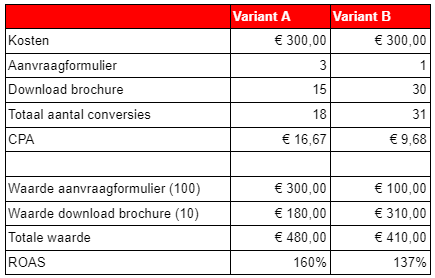
When maximising conversions and targeting CPA, the ‘B’ variant will be better for Google. More conversions are generated (conversions max) and the target CPA is lower. However, if we assign a value of 100 euros to the enquiry form and 10 euros to a brochure download, Google will regard variant A as the better option. This is because it generates 480 euros instead of 410 euros. In that case, you should choose ‘maximise conversion value’ rather than focusing on conversions. By assigning values, you add nuance to the importance of certain actions. And this is important when setting up your soft conversions.
This method can be used for both e-commerce and lead generation. In e-commerce, for example, think of soft conversions such as ‘request a colour sample’, ‘request a quote’ or ‘add to basket’. For leads, these could be buttons or a user who has reached a certain scroll depth. Naturally, you’d prefer the values you assign to actually correspond to what it’s really worth, but you can, of course, also use fictitious values. The main thing is that you want to feed the algorithm and steer it in the right direction.
We believe that, with a few exceptions, you should always aim for a target ROAS as the ultimate goal in your roadmap. You map out what the conversion points yield and tell the algorithm how much it is allowed to spend on them and what return must be achieved. With Smart Bidding, there’s a clear distinction between the different objectives, achieved by setting specific values, which enables the algorithm to really get to work to deliver the right performance for you. You clearly tell Google what you want and have a great deal of control over what information it can use to achieve this. That way, you retain much more control over your campaigns, without having to constantly tweak the settings yourself. Good luck!




Our team is
ready to help you

