Proud partner

Proud partner
Article


Google is highly innovative and continues to roll out new features and functions in Google Ads. But are all these changes actually an improvement? In this blog, you’ll read about Responsive Search Ads (RSA) – not just what they are, but also how they perform!
Responsive Search Ads (RSAs) are a type of search ad format offered by Google Ads. RSAs are designed to offer advertisers greater flexibility and personalisation when creating text adverts for search engines. Google encourages the use of RSAs as they can improve the relevance and effectiveness of adverts. Within the Google interface, you enter multiple headlines and description lines. Google then uses its algorithm to automatically construct the advert using these various elements. It therefore selects two or three headlines from your list of headlines that Google considers most relevant at that moment and combines them with one or two description lines from your list of description lines. This is what it looks like in the interface:
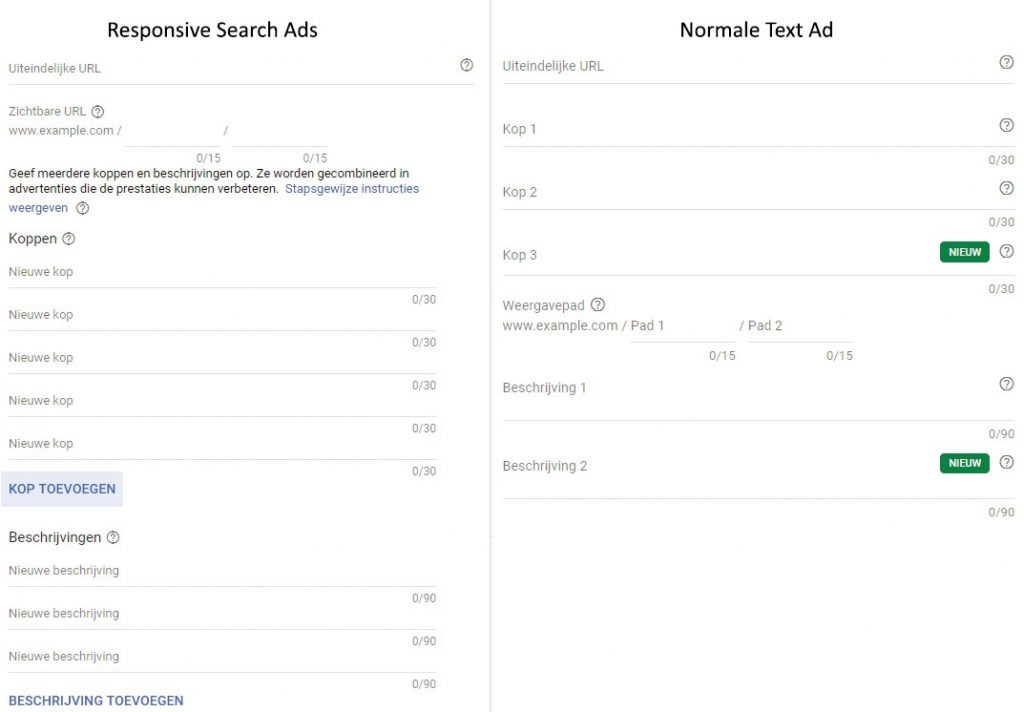
Whereas you would normally decide what to include in each advert, Google helps you find the best match with Responsive Search Ads. You simply specify what you want in the headline and which description should be displayed.
Google encourages the use of RSAs because they help advertisers achieve better results and provide users with adverts that are more closely aligned with their needs and interests. It is therefore a smart move for advertisers to incorporate RSAs into their digital marketing strategies to optimise their advertising campaigns and reap the benefits of this powerful advertising format.
Responsive Search Ads have now become an integral part of our SEA specialists’ strategies. Key conclusions they have drawn in recent years include:
• Cost per click (CPC). When we analyse the data, we see that only a small proportion (16%) of RSA adverts perform better in terms of CPC. The majority of RSA adverts are actually more expensive per click than standard adverts – approximately 20% higher.
• Click-through rate (CTR). You would expect a more targeted advert to have a higher click-through rate.
The ad in this new style should be more relevant to the reader. However, we see absolutely no evidence of this in the data.
They perform at roughly the same level as standard adverts.
• Machine Learning. We’re seeing that, over time, Responsive Search Ads are improving in terms of results.
Thanks to machine learning, AdWords is better able to identify which combinations work well and which do not. So don’t jump to conclusions; give it time.
Based on the data, we’d say: definitely give it a go. For some accounts, it works much better (more conversions!), but there are also accounts that pay more per click for the same results. So it really depends on the account and campaign. You do need to be careful when setting up these adverts: if you don’t configure certain elements of the advert properly, you can end up with some very strange combinations in the adverts. If you’d like help setting up Responsive Search Ads, you’re always welcome to get in touch with us. We’d be happy to help.




Our team is
ready to help you

