Proud partner

Proud partner
Article

‘From zero to hero’ – that sounds like music to the ears of many a business. It seems to be possible by applying guerrilla marketing in exactly the right way. But how do you do that? And is it useful for lesser-known companies? Well, that largely depends on the purpose of your brand and company, but we’ll come back to that later. Let’s start at the beginning.
The term ‘guerrilla marketing’ is derived from guerrilla warfare, the militant strategy whereby smaller, mobile and sometimes civilian forces carry out irregular attacks in enemy territory. Attacks include ambushes, raids and other surprise manoeuvres. In guerrilla marketing, we leave the warfare aspect aside, but the surprise (or ambush) elements are used to create a memorable marketing experience. The aim of a guerrilla marketing strategy is therefore to create impactful and memorable experiences on a lower budget. This makes guerrilla marketing an ideal choice for small businesses.
Guerrilla marketing, as it were, disrupts consumers’ daily routines by confronting them with unconventional methods of brand interaction. The idea is to generate a conversation, a stir or something newsworthy, so that brand awareness spreads through word-of-mouth or media coverage. So you could say: the crazier the guerrilla marketing, the better.
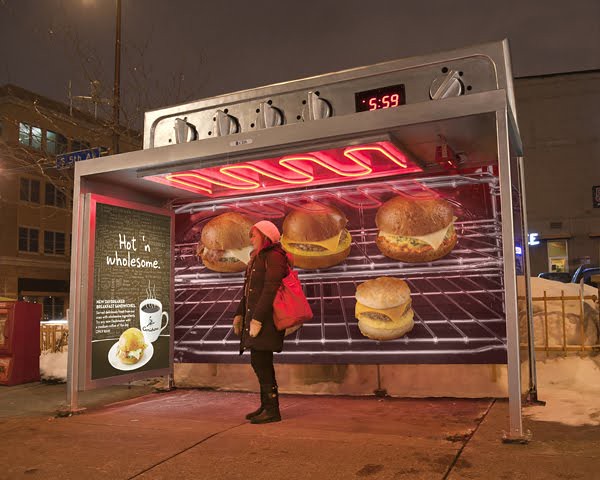
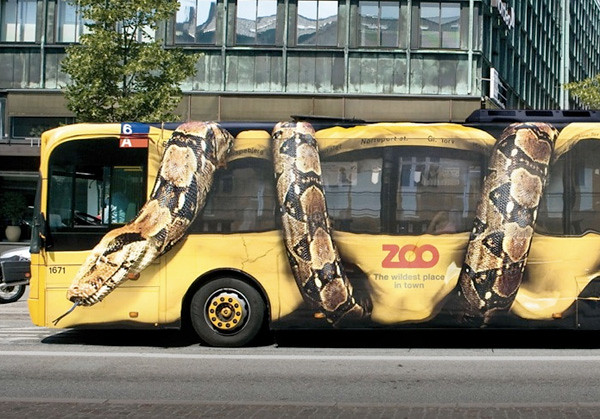
Most guerrilla marketing campaigns work best in urban areas with high footfall or dense, slow-moving traffic. This is partly why it is sometimes referred to as street marketing. Although street marketing is a niche field, there are nevertheless a number of sub-categories that can be identified:
Outdoor guerrilla marketing adds something to existing urban environments, such as placing a removable object on a statue or creating temporary artworks on pavements and streets.
Similar to outdoor guerrilla marketing, the indoor variant often takes place in covered locations such as railway stations, shopping centres and buildings on university campuses, for example.
Events such as concerts or sporting events are often used to promote a product or service in a high-profile manner, usually without the consent of the event’s sponsors.
A flash mob is a group of people who perform an unusual act in a busy space or environment, such as an unexpected dance, singing or acting performance. It is often great fun and highly effective as a guerrilla marketing technique.
Although this strategy is mostly implemented offline, online guerrilla marketing is also becoming increasingly popular. Take, for example, temporarily taking over a well-known Instagram account! What’s more, an offline and online strategy can also go hand in hand.
Online marketing has given small businesses on a tight budget new opportunities to communicate with the right target audience. Guerrilla marketing and digital media can be a perfect way to engage the target audience. Both large and small businesses have used guerrilla techniques in their online operations, creating memorable campaigns as a result. Guerrilla marketing is unconventional, surprising and full of energy. All these aspects can also be achieved online.
But how exactly do you go about implementing an online guerrilla strategy?
The most important aspect of online guerrilla marketing is this: make it unforgettable. Come up with something unique and create a ‘wow’ moment. The smarter the campaign, the more memorable it will be – even after just one exposure. Only when you really make an impression will people be slow to forget your brand!
There are countless examples of guerrilla marketing. Companies all over the world have embraced this marketing strategy and used it to launch products onto the market.
Below are a few of our favourite examples of famous guerrilla marketing campaigns to inspire you.
In Los Angeles, guerrilla marketing was used to promote the launch of the new King Kong 360 3D attraction. A series of enormous footprints and a crushed vehicle were left on Santa Monica beach. In addition, the video suggests that King Kong had caused damage at Dodger Stadium.
People took photos and shared them frantically on social media in an attempt to work out what it all meant.
Zeeman proved that fashion doesn’t have to be expensive with a spectacular guerrilla marketing stunt during Amsterdam Fashion Week in 2011. Under the name FRANK, the clothing chain staged a fashion show for the crème de la crème of the fashion world. At the end of the show, it was made clear that the garments were ‘ordinary’ Zeeman clothes. This highly acclaimed campaign won several awards.
Coca-Cola has always been known for its brilliant guerrilla marketing campaigns.
The brand launched an online video with the slogan “Coke Zero drives you to unlock the 007 in you”, after which unsuspecting travellers were challenged to find the 007 within themselves. The prize? If participants managed to complete the task within 70 seconds, they won exclusive tickets to the new James Bond film, Skyfall. It was the perfect way to generate buzz for Coca-Cola Zero and Skyfall through guerrilla marketing. The campaign was a huge success; it was viewed 4 million times on YouTube within a week.
This brings us straight to the final tip for setting up your online guerrilla strategy: finding the connection between offline and online. Platforms such as YouTube are ideally suited to sharing your offline guerrilla marketing stunt with a wide online audience. This also applies to QR codes that can be physically scanned or hashtags placed offline to be used online on social media.
To develop the right strategy, you start at the beginning:
Think carefully about the aim of your guerrilla marketing campaign. Do you want to draw attention to specific products? Or do you want to increase your company’s brand awareness? A successful guerrilla marketing stunt starts with a clear end goal. If your objective and campaign aren’t properly aligned, there’s a good chance it will fail.
It is important to thoroughly analyse your target audience. Understanding your customers is essential for a successful guerrilla marketing campaign. If you know who your customers are and how to reach them, a campaign can be successful. Identify where your target audience is (online or offline) and what interests them. Once you have this insight, you can respond precisely to your target audience’s needs.
Not all guerrilla marketing campaigns cost a lot of money. However, they often do take a lot of time. It is important to have a clear idea in advance of how much you want to invest in your guerrilla campaign – in terms of both time and money.
It is important that your campaign showcases something new. Try to be original and unpredictable. If you manage to make people laugh with your campaign or briefly take them away from reality, you’ll be better remembered. You’ve already identified your target audience; now make sure this group can identify with your campaign. When people identify with your campaign, they’re more likely to share it on social media.
Don’t forget your channels! Free publicity is still hugely valuable. Create a dedicated landing page for your guerrilla marketing stunt and include a follow-up on your website where you encourage visitors to take action. You can also reach your audience via a press release or your social media channels.
Guerrilla marketing is a useful tool, but it can also have several drawbacks. If you adopt the wrong strategy, you run the risk of it backfiring. You should therefore avoid the following:
Make sure the campaign aligns with your company’s identity and core values. No matter how viral your guerrilla campaign becomes, if people subsequently remember nothing about your company or cannot make the connection, it’s of no use to you.
In guerrilla marketing, a campaign can also backfire, for example if the message isn’t clear. The most important thing is that your target audience understands the message. If it isn’t clear, you won’t reach your target audience and it won’t generate the enthusiasm that was intended. Furthermore, guerrilla marketing often involves doing something unusual in public – after all, you want to stand out. Doing something unusual in public can also be perceived as annoying by those around you.
Furthermore, a genuine guerrilla marketing campaign often treads a fine line when it comes to the relevant legislation. It can quickly lead to a breach of the law and potential fines. If a guerrilla campaign fails, this can result in negative publicity and damage to the organisation’s reputation.
New entrepreneurs with a limited advertising budget can give their brand awareness a significant boost through a well-executed guerrilla marketing campaign. Like any investment, however, this must be approached with a cost-benefit analysis and be genuinely original. You should therefore ask yourself the following questions:
Guerrilla marketing, just like entrepreneurship, is about taking risks. It is the risk that ultimately makes an investment lucrative. It is the risk – the daring – that makes these kinds of tactics so appealing to the masses. That’s what makes people sit up and take notice. So, do you dare to take the risk?
Perhaps guerrilla marketing is still a step too far for you, but you’re already ready for a bold online growth strategy. For example, using search engine optimisation or link building. In that case, the team at Traffic Today is here to help! With our creative minds and strategic mindset, we’ll work together to drive growth.




Our team is
ready to help you

