Proud partner

Proud partner
Article
Summary


In October 2025, Google announced the roll-out of AI mode in Google Search. The feature is now also available in Dutch and marks an important step in the evolution of search behaviour. Whereas we used to search mainly by keywords, the focus is now on context, nuance and natural interaction. AI mode helps users better understand what they are searching for and provides more direct, richer and more relevant answers than ever before.
AI Mode is Google’s latest addition to its search ecosystem. Whereas previously you would enter a search query and receive a list of results, AI Mode immediately presents a summarised answer – supported by contextual links to relevant websites. The feature is now available in Dutch and 35 other languages, across nearly 50 countries. With this update, Google is making the transition from a search engine to an answer engine.
The AI mode utilises the latest version of Google’s Gemini models. These models can execute multiple search queries simultaneously using a technique Google calls ‘query fan-out’. This means that a single query is broken down into several sub-queries, which are then answered simultaneously. The result is an integrated, contextual summary with references to the best sources on the web. Thanks to multimodality, you can search using text, speech or images, making the user experience even more natural.
For marketers, the advent of AI mode heralds a new phase in search engine optimisation. The traditional number one position in Google is no longer the sole objective. Instead, the focus is shifting towards visibility within AI overviews, also known as AIOs. When Google selects content for an AI overview, it’s a sign that your website is reliable, relevant and well-structured. Brands that respond to this early on will benefit from higher click-through rates and higher-quality traffic.
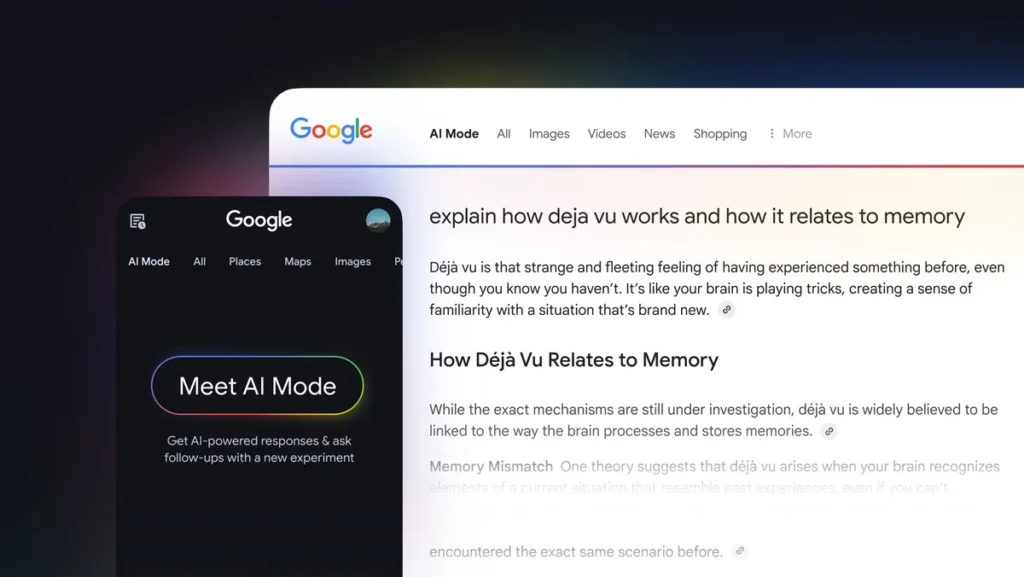
The advent of AI mode does not spell the end of SEO, but it does mark a shift in approach. In this new search experience, Google favours content that provides direct answers to complex questions, rather than generic texts packed with keywords. This calls for content that goes deeper and is written from a position of expertise and experience. For SEO specialists, it is more important than ever to focus on semantic clusters and content that addresses genuine user queries.
Google emphasises that factual accuracy is central to its AI mode. Answers are compiled based on existing, reliable sources. In situations where the certainty of an answer is too low, Google prefers to display traditional search results. For businesses and marketers, this means that quality, source attribution and timeliness directly influence your visibility. Content that is carefully substantiated is given priority.
AI mode is available as a separate tab in the search results and via the Google app on Android and iOS. Users can type, speak or even upload photos to search for information. The interface is designed to be intuitive: you can ask follow-up questions, compare results or view visualisations without having to re-enter your search query. The aim is to make searching feel more like a conversation than a command line.
At Traffic Today , we see AI mode as a logical next step in Google’s evolution. The way people find information is constantly changing. AI helps us understand what someone is looking for more quickly and deeply, but strategy remains a human endeavour. Ultimately, online visibility still revolves around relevance, trust and creativity. Tools such as AI mode actually give marketers the opportunity to respond more intelligently to search behaviour and user intent.
At Traffic Today , we closely monitor developments in AI within search engines. Would you like to know what AI mode means for your website, or how you can optimise your content for this new search experience? Please feel free to contact us. Together, we’ll ensure your brand remains visible in a world where AI and search behaviour are becoming increasingly intertwined.




Our team is
ready to help you

