Proud partner

Proud partner
Article
Summary


To prevent communication from becoming a one-way street, Betteke van Ruler has described the ‘communication crossroads’. Thanks to the communication crossroads, you can assess which communication strategy is best suited to a specific situation. In this blog, we’ll tell you all about this model.
Betteke van Ruler’s ‘communication crossroads’ offers guidance when choosing a communication strategy. There are two questions that play a key role here:
Question 1 relates to the horizontal axis. Question 2 relates to the vertical axis. The answers to these questions led to one of the four basic communication strategies. Based on the answers to the above questions, it can be determined which type of communication is best suited. Four types of communication have been identified in the communication matrix, namely:
The communication matrix consists of a horizontal axis (X-axis) and a vertical axis (Y-axis). The horizontal axis represents the degree of awareness and influence. On the vertical axis, one-way communication is contrasted with two-way communication.
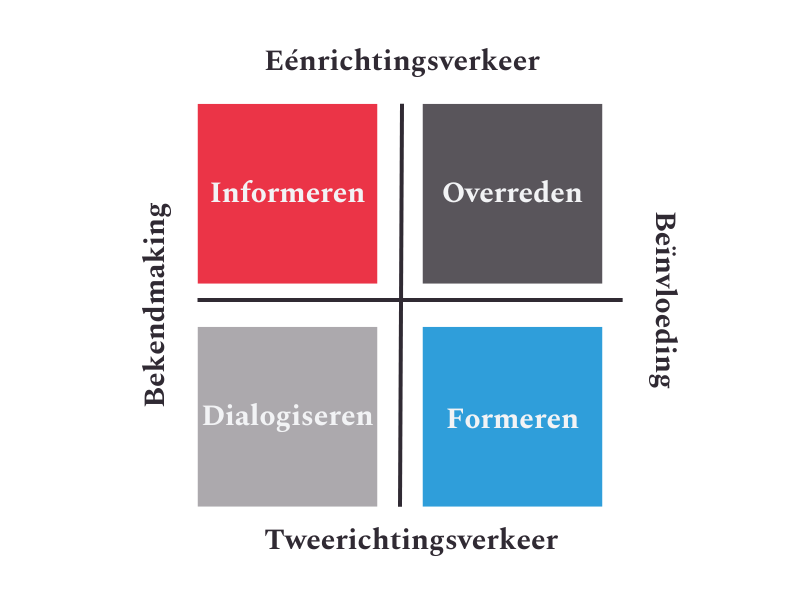
Is the communication one-way? And do you want to use this form of communication to convey a message or information? If so, it falls under the category of ‘informing’.
With this strategy, you aim to inform your target audience so that you convey the message to them as effectively as possible. You want to get your intended target audience thinking. They need to form their own opinions based on the message. This strategy is primarily about one-way communication, combined with the aim of raising awareness. You want to get people thinking or to prompt them to make a decision.
Take the news broadcast as an example. You convey information in a neutral manner. You give the target audience the opportunity to form their own opinion about the message.
If communication comes from just one side, but you still want to influence someone, then this is known as persuasion.
With this strategy, you focus on attitude, behaviour and knowledge. You aim to influence the target audience with your message in these three areas. Mass communication is often used. Social media, for example, is a suitable platform. Positioning your organisation is a form of persuasion, just like propaganda.
Take advertising, for example. You convey information with the aim of guiding your target audience. You want to influence them with your message.
If communication flows in both directions and there is no attempt to influence the other party, then this constitutes a dialogue.
Engaging in dialogue means that, as an organisation, you enter into a conversation with your target audience. The aim is to gauge opinions. You also want to solve problems. For example, by gauging opinions. What does your target audience think of your company or your services? It is always a two-way process, in which you do not wish to influence the target audience.
Examples include a meeting, webinar or consultation. The target audience must always have the opportunity to respond.
Do you want to engage with your target audience and keep the conversation going? Then this is what we call ‘formation’.
The aim of ‘forming’ is to influence the target audience whilst engaging them in dialogue. This communication strategy is employed, for example, when there are conflicting interests. It is also used to maintain relationships with stakeholders. ‘Formeren’ is also commonly used in politics, for example, following elections to form a new government.
By working with Ruler’s communication crossroads model, you carefully consider in advance the sender, recipient, message and the medium you are using. The choice of one of these strategies is not set in stone. During a project, the strategy may change, which means your choice within the communication crossroads may also change. Sometimes it makes sense to choose multiple strategies, for example if you are using different forms of communication.
If you make informed choices based on the model, there is a good chance you will build a lasting relationship with your target audience. Another advantage of the model is that it is clearly defined. Because each component has specific functions, it can be deployed effectively for each specific objective.
Thanks to Ruler’s communication crossroads, you can prevent one-way communication from occurring. Maximise the impact by applying the crossroads in a way that suits the intended strategy.




Our team is
ready to help you

