Proud partner

Proud partner
Article
Summary


Whilst companies used to be able to expect potential customers to come to them automatically, this is no longer a given. Consumers are far more discerning and are finding more and more alternatives via social , the media and search engines. By responding effectively to the needs or interests of the target audience, you can win over the consumer. A good content strategy helps you achieve this. But what is the best way to go about it?
A content strategy is a strategy centred on business objectives, where content is used as the primary means of achieving these objectives. One objective might, for example, be to increase brand awareness. To achieve this objective, you can implement a content strategy that focuses on SEO (search engine optimisation) to boost your website’s visibility on search engines and drive traffic to your products or services.
Content marketing helps businesses prepare for and plan website traffic and new leads. Just one blog post with a link to your website can generate a steady stream of organic traffic. In principle, a good content strategy forms the basis of the early stages of the customer journey. As well as attracting new potential customers to your brand, you can also use a content strategy to boost sales and improve overall customer satisfaction.
Given that 70 per cent of marketers are actively investing in content marketing, it is often crucial to develop a sound content strategy in order to compete effectively within your sector – and thereby attract and retain the attention of your target audience.
Firstly, it is important to identify the target audience for your content. Your content strategy can be aimed at more than one type of reader or viewer. By using different types of channels, you can deliver different types of content to each relevant target audience.
Ideally, your product or service solves a problem for your target audience. Consequently, the content should align with the solution you offer to that problem. After all, the content reinforces the need for the solution(s) you provide. Furthermore, there are likely to be similar products or services on the market, which means that your organisation’s USPs must be clearly defined.
First and foremost, it is important to determine how your brand is positioned in the market. How is your company or organisation perceived? You can investigate this by reading reviews posted about your brand or by analysing reactions on social media. You can also conduct a survey and ask (potential) customers how they experience your brand.
But who exactly are your potential customers? In other words: which target audience do you want to reach? Write it down, as this will give you a clear picture of your customer and enable you to better meet their wishes and requirements. Do you run a fashion webshop aimed at young women? If so, focus on girls aged 15–25 and find out more about their hobbies and interests, as this will enable you, as a brand, to respond effectively to their needs. It’s also always useful to know which social media platforms your target audience uses. This is where you’ll want to have a prominent presence.
To gain even more insight into your target audience, it’s a good idea to identify who your competitors are. How do they reach their target audience? And what extra step can you take with your brand to ensure the customer chooses your company over the competition? List your USPs and think carefully about how you want to bring these to the attention of potential customers.
Once you’ve identified your target audience, it’s time to get to know your customers better. What are the most popular topics on your website and social media accounts? How do people find their way to your website? What do people search for most on Google?
By mapping this out, you gain a clear picture of the paths your customers take on your website or social media accounts. The results are based on facts: in short, useful information that you can build on.
Have you identified your target audience and gained an understanding of your customers? Then it’s time for the next step: set goals. What do you want to achieve with content marketing? How will you measure its effectiveness?
One objective within your content strategy might, for example, be to increase profits by 20 per cent within six months. You can achieve this by selling more or attracting more customers.
It is also important that every content page has a specific purpose. That way, you know what you’re going to measure. By thinking in advance about the purpose of your blog or page, you can write more specifically with that purpose in mind. This could, for example, be to generate sessions to build brand awareness, but it could also be a supporting page for a category via an FAQ, allowing both pages to link to one another.
But how do you actually attract more people? How does your company’s website rank in search results? And to what extent can your potential customers find you via relevant social media channels? There’s certainly still room for improvement. Draw up a plan and keep your objective(s) in mind, so that you can work in a targeted manner.
It is also important to create content for every stage of the customer journey. Visitors have different needs and may be at various stages of the buying process:
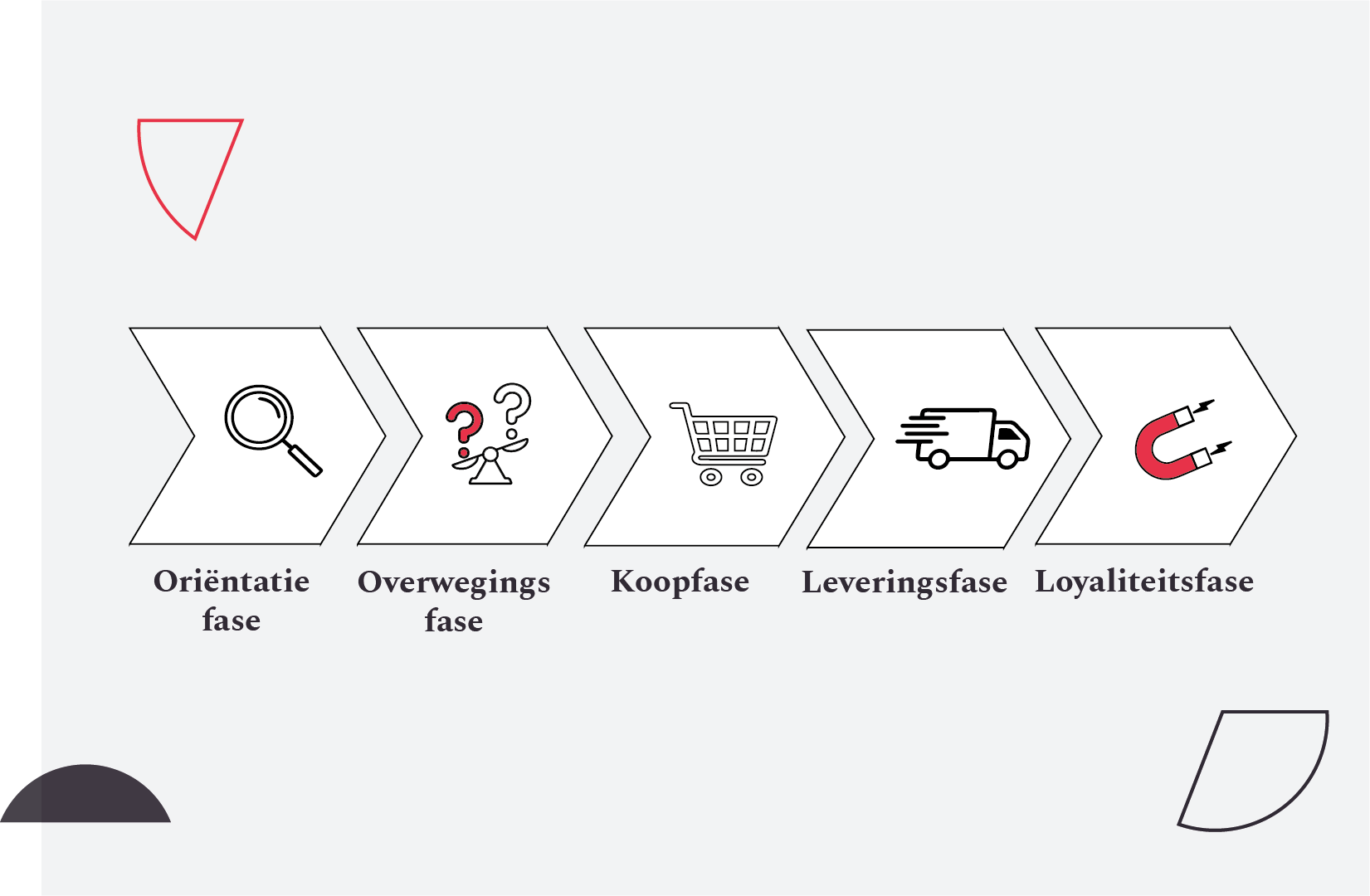
Read more about the customer journey in our blog ‘See, Think, Do, Care: the power of the customer journey’
Which channels do you want to use for your content strategy? Always take a close look at your website: after all, this is where your customers end up when they want to buy something or use a service. But how can a consumer find your website? The content on your website influences its discoverability. Does your website still have very little content? If so, we strongly recommend that you fill it out quickly and ensure it is properly optimised. Do make sure you always publish SEO-friendly content. So make sure to use the key search terms you want to be found for. Google Ads’ Keyword Planner can help you gain insight into search volume.
For example, do you run a restaurant in Deventer? Then naturally you’ll want to be found using the search terms ‘restaurant in Deventer’. The search terms ‘eating out in Deventer’ are also relevant.
It’s also always a good idea to look at the social media channels where your target audience is active. Social media is an accessible way to grab your target audience’s attention. So pay close attention to setting up an account, posting updates and creating adverts.
Don’t start creating content haphazardly; instead, take a targeted approach. Introduce structure and make use of a content calendar. This will help you determine what type of content to create, for which target audience, and for which channel.
Ensure a diversity of content. In your content strategy, pay attention to the various forms of communication. So think carefully about text, video, images, podcasts, web social s, and so on. Different objectives may call for different forms of communication. For example, when explaining a product, it may sometimes be clearer for a visitor to view a screen recording or product video rather than (just) a textual explanation.
Would you like to start blogging for your business? If so, make sure the topic doesn’t overlap with that of any of your existing pages. It’s quite common for blog posts to end up ‘competing’ with another page on your website. By creating an overview in advance of the search terms you’re writing for, you can prevent the new page from competing with an existing one. Internal competition has a negative effect on the overall rankings of your online shop or website, meaning you’ll miss the mark. This is also why – contrary to the standard advice to host a blog on the same domain – some organisations host a blog on a subdomain to prevent this internal competition. The Ahrefs chart below shows how a blog page competes with a web page:

If several pages contain the same keyword, Google does not know which one to assign the most value to. In that case, each page receives a little attention. However, you would prefer one of the pages to receive all the attention and thus appear at the top of the search results. You should therefore decide in advance which terms you are going to write about to avoid competition.
But how do you actually go about creating content? Here are a few useful tips:
It is clear that an effective content strategy is vital for achieving business objectives. Developing a content strategy can be complex, which is why the following section sets out a step-by-step plan to guide you through the process.
1. Define the objective
What is the aim of content development? Set objectives before you start planning, so that these can be taken into account during strategy development.
2. Conducting target audience research
To develop a successful plan, the target audience must be defined. This is particularly important for entrepreneurs undertaking marketing activities for the first time. By knowing your target audience, you can produce relevant and valuable content that they want to read. It is important to carry out regular market research to ensure the customer base continues to grow
3. Carry out a content audit
If you’ve been working on content for a while, take a look at your content marketing efforts and the results they’ve yielded by carrying out a content audit. Find out what you can do differently in the coming period and set new goals. This is a good time to align your team’s goals with the rest of your business objectives.
4. Choose a suitable content management system
Set up a system where you can create, manage and track your content – also known as a content management system (CMS). Some essential aspects of content management include creating content, publishing content and analysing content.
5. Brainstorming ideas for content
During this stage, as many ideas as possible are generated regarding the content to be written. Initially, aim for quantity over quality. ‘Overthinking’ stifles the creative process.
6. Decide what types of content you want to create
There are various options available for the content you can create. The most popular content formats that are widely used are blog posts, videos, podcasts and posts on social media.
7. Publish and manage content
Your content strategy must go beyond the types of content you create – it must also cover the organisation of this content. Effective content planning is a practical tool that helps you schedule your campaigns and projects, determine when and where content should be published, and identify who is responsible for it. With content planning, you always keep your target audience and business objectives in mind.
It’s time to get started on creating your own content strategy. Do you need any help with this? Please feel free to get in touch with us. Our content marketers are here to help and will be happy to assist you.




Our team is
ready to help you

